
Building Asheville’s “Zoning Buffer”
November 6, 2023
This member commentary post does not necessarily reflect the views of Asheville For All or its members.
This member commentary post does not necessarily reflect the views of Asheville For All or its members.
Last month, Asheville’s city planning department briefed the Neighborhood Advisory Committee on the Flag Lot Amendment that the City Council will be voting on in January.
I wrote about that amendment here, and you can find the city staff briefing here.
There’s something interesting about the language in the memo. On one hand, staff rightly note that Asheville has a severe housing shortage, and that “we must find ways to provide additional housing.”
On the other hand, there’s some handwringing about the potential for this flag lot proposal—which would allow homeowners to build additional homes on unused land as a means to create more infill density—to “accelerate displacement.” Does this mean that we are forever facing a Catch-22? We need more homes, but we can never increase the city’s capacity for them?
We know that displacement is happening right now in Asheville. It’s happening because rents are rising fast, and that’s because in a landscape of severe shortage, landlords can effectively have their pick of tenants, and can charge what they want. It’s happening because tenants are being pitted against one another, forced to “bid up” the price of housing. (And the same is true for homebuyers, especially first-timers.) And it’s happening because when someone has to move—say their family outgrows their present accommodations—there is nowhere else to go. There are so few vacancies.
Personally, I believe that the stress we place on the potential for pro-housing changes to cause displacement is short-sighted and driven by a status quo bias. After all, the status quo is seeing people being driven out of their homes right now, possibly every day.
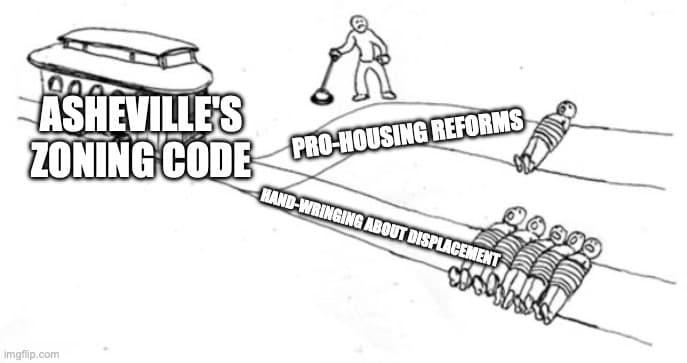
(It’s a bit like the famous “trolley problem.” Sometimes it feels like we’d rather do nothing, even if it means the housing crisis will only get worse.)
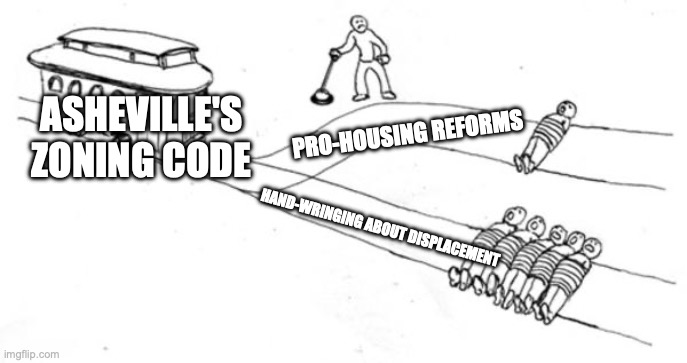
We can greatly reduce displacement pressures with pro-housing reforms. So why do we so often see handwringing that suggests the opposite?
But let’s take the dominant narrative around displacement seriously for a moment—the dominant narrative, I think, being that which sees “development” as a threat to housing stability. It’s an absolute fallacy that more housing, even fancy new housing, causes rents and/or home prices to rise. But what about the concern that new, pro-housing land use reforms to our zoning code—which we might call “upzoning” for short—will lead to speculation or market churn in the short term that will put people out of their homes?