
Asheville City Council - August 26th Meeting
September 2, 2025
Here’s what we found to be the most important housing-related items at Asheville’s City Council meeting of Tuesday, August 26, 2025.
Here’s what we found to be the most important housing-related items at Asheville’s City Council meeting of Tuesday, August 26, 2025.
The Latest Bowen Report
It’s not uncommon for presentations to be delivered at Asheville City Council meetings, unconnected with any vote or hearing. On this occasion, Bowen National Research had completed a major study of a four-county region in Western North Carolina, with Asheville at the center, and its housing needs.
Bowen has actually been employed to study Western North Carolina’s housing problems before, with previous studies in 2015, 2019, and 2021.
Patrick Bowen delivered the presentation to the council, limiting his time to a birds-eye view of the report, and focusing on the broad trends that were specific to Asheville. He noted for example, that vacancy rates for the city had improved somewhat for market-rate housing since 2021, though they are still not high enough to be considered “healthy.” He also noted that waitlists for income-restricted housing are still long, and vacancy rates are lowest for the apartments that serve the lowest income populations.
Several city councilors had good questions for Bowen, following the short presentation. You can watch it on the city’s YouTube channel here, with a later timestamp marking the start of council’s questions.
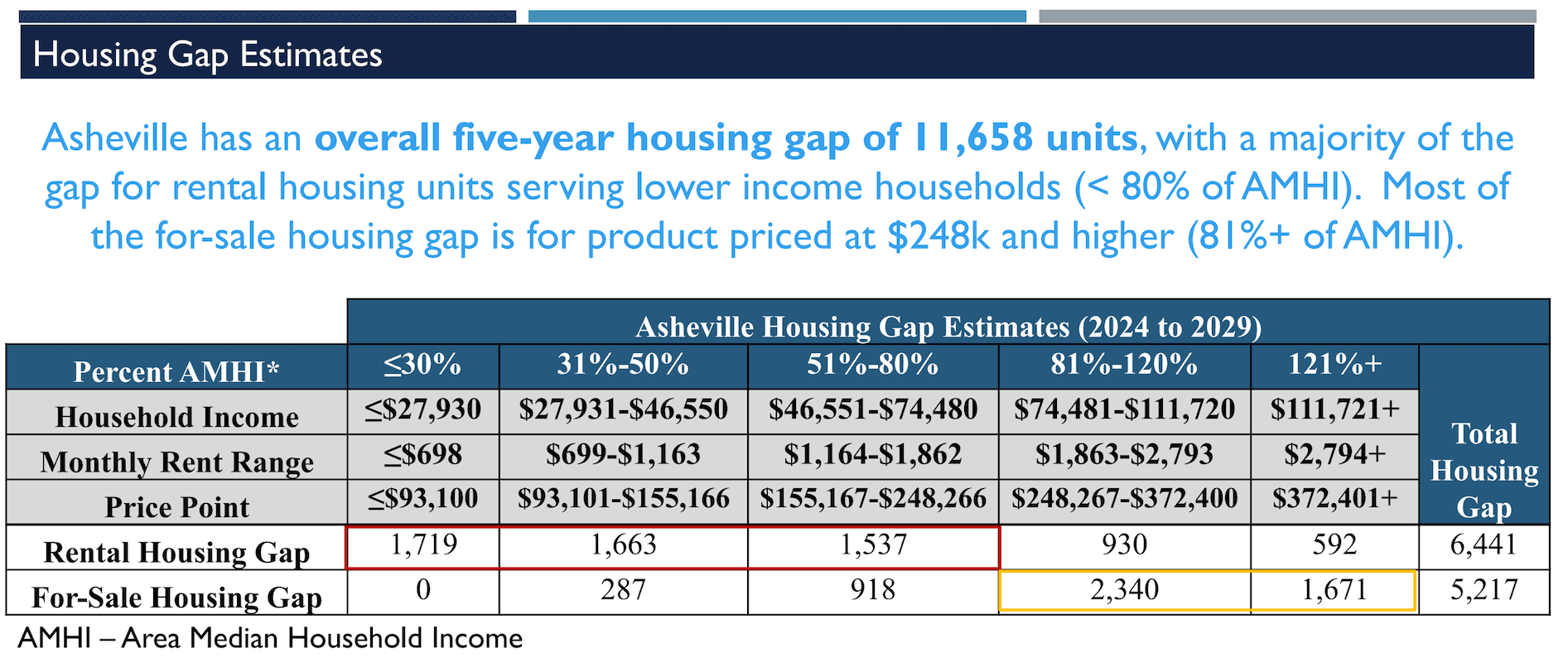
We just want to highlight one question from Mayor Manheimer that was an important reminder and clarification. She asked, in response to the slide shown below, “You have all these different buckets. How does it affect other buckets if you are adding housing stock in one bucket?”
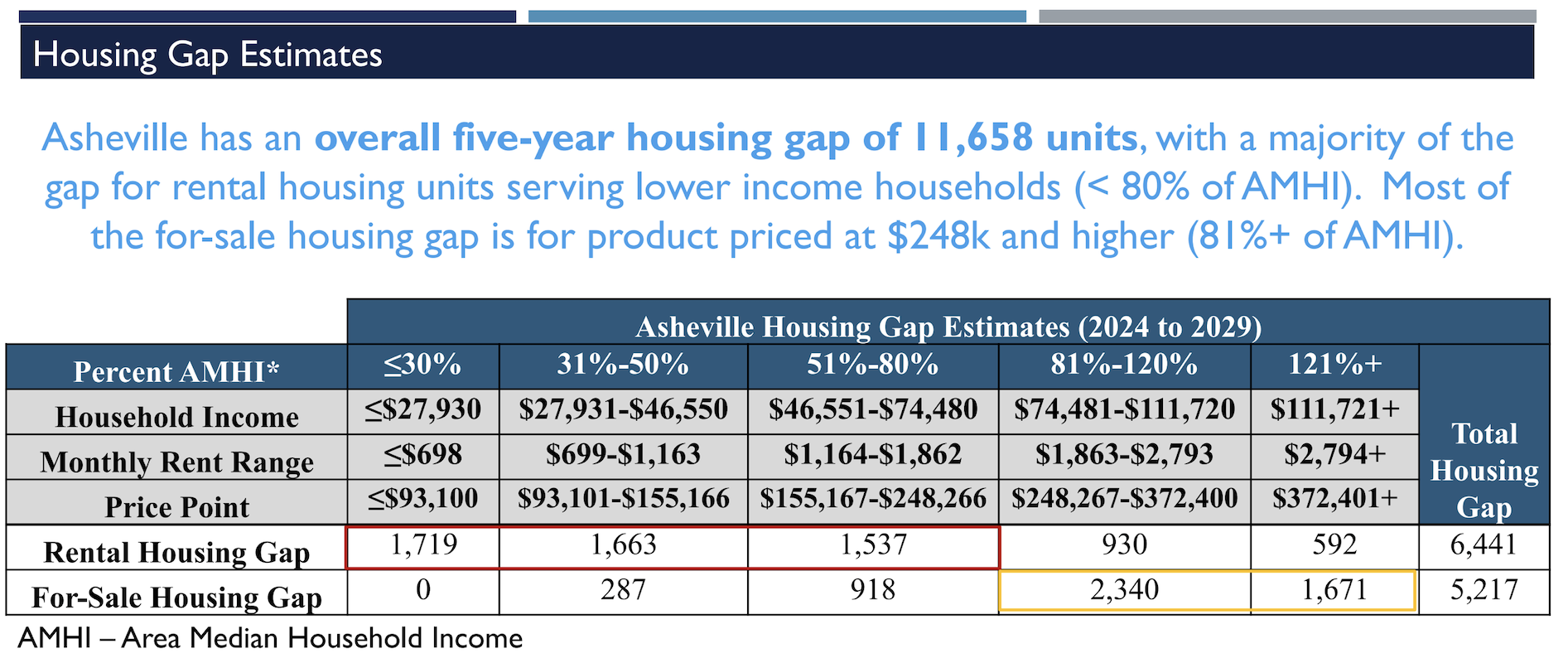
A slide from the new Bowen Report breaks down the city’s housing supply gap by cost ranges. You can view all of the presentation slides here.
Bowen’s response, which the mayor anticipated, was that yes, in fact, these things are interconnected. “If you [add] senior housing that would allow seniors to downsize,” for example, “they just freed up all this housing stock…that could be older…so…it might be more affordable.”
The point is that even if the greatest deficit—that is, the lowest vacancy rates—in Asheville’s housing stock is for homes that would serve populations earning below the area median income, and homes at this price point simply cannot be built in the city at today’s construction costs without generous public subsidies, freeing up existing older homes is one way to effectively add homes that people can afford. In fact, it’s likely the primary way that cheap homes have historically become available to working people in high-demand cities, and .