
Policy — Inclusionary Zoning
April 28, 2024
Inclusionary Zoning sounds like a good policy for promoting affordable housing. But what are its actual effects?
Jan 27, 2025 Edit: We recently released our study on Inclusionary Zoning in Pittsburgh
This is the fourth entry in our ongoing Policy series. Pittsburgh is in the midst of a severe housing crisis, with many neighborhoods becoming increasingly out of reach for many families. While the causes for our housing problems today are many, the goal of Pro-Housing Pittsburgh is to advocate for each and every change that can lessen the extent of the crisis. Each entry in this series describes a specific Policy that can be undertaken by the local government to help with the housing crisis in Pittsburgh.
What is Inclusionary Zoning?
Inclusionary Zoning (IZ) is a policy that requires developers to set aside a certain percentage of units of new construction as affordable. Affordable is defined as a function of the “Area Median Income” (AMI) for households.
IZ is a policy that many policymakers pursue because it seems like a great deal to the public - it's pitched that developers will, at their expense, cover the cost of building affordable housing for the city whenever they build a new building. We'll take money out of developer’s pockets, and the public will get all the benefits.
The reality, however, is quite the opposite. IZ is de facto a tax on new residential development (Schuetz et al, 2011). The incidence of that tax falls on both developers and renters. By requiring a developer to set aside some units to rent or sell at below market rate, it decreases the amount of revenue a project can earn. Since a developer decides to build based on the revenue of a project versus its costs, IZ will cause some projects to not be viable - i.e. the costs will exceed the revenue, and the project will not be built. This also means that IZ requires high market rents for anything to be built to subsidize the IZ units - in neighborhoods where rents are lower, or if market rents moderate, IZ projects will never get built because projects won’t be financially viable.
From a housing affordability perspective, IZ policies constrain housing supply, which pushes up overall prices. As we noted in our post on filtering, every 100 new market-rate homes creates 45-70 homes affordable to those with below median incomes, including 17-39 homes affordable to the bottom quintile. (Mast, 2023)
While IZ can create a small number of immediately affordable units in buildings that would not otherwise have affordable units, the tradeoff is that for every 20-25 newly affordable units created by IZ, 100 new market-rate units are lost. (Phillips, 2024)
Further, each affordable unit mandated by Inclusionary Zoning costs the same to build as a market rate unit - around $400k-$500k for the typical unit. In this example, 35 permanently affordable units are built by Action Housing for $16 million, or approximately $460k per unit. Since typical affordable units sell for approximately $150k, the developer incurs a loss of around $250k to $300k dollars for each affordable unit. That difference comes out of someone’s pockets. If it is shouldered by the developer, then the incidence falls on the developer, the residents of the building, and the increased rents and housing costs faced by everyone else in the city from the constraint on housing supply. If it is shouldered by the city, then it comes out of the pockets of everyone in the city through increased taxes.
These losses in housing supply can be reduced by pairing Inclusionary Zoning with upzoning and funding for affordable units. If the city eases zoning restrictions on projects with mandated affordable units and subsidizes those affordable units, then that could increase the number of homes constructed, and improve affordability broadly.
However, we must emphasize that these policies of upzoning and subsidizing affordable units would create even more housing if Inclusionary Zoning was not included.
How does Inclusionary Zoning affect Pittsburgh?
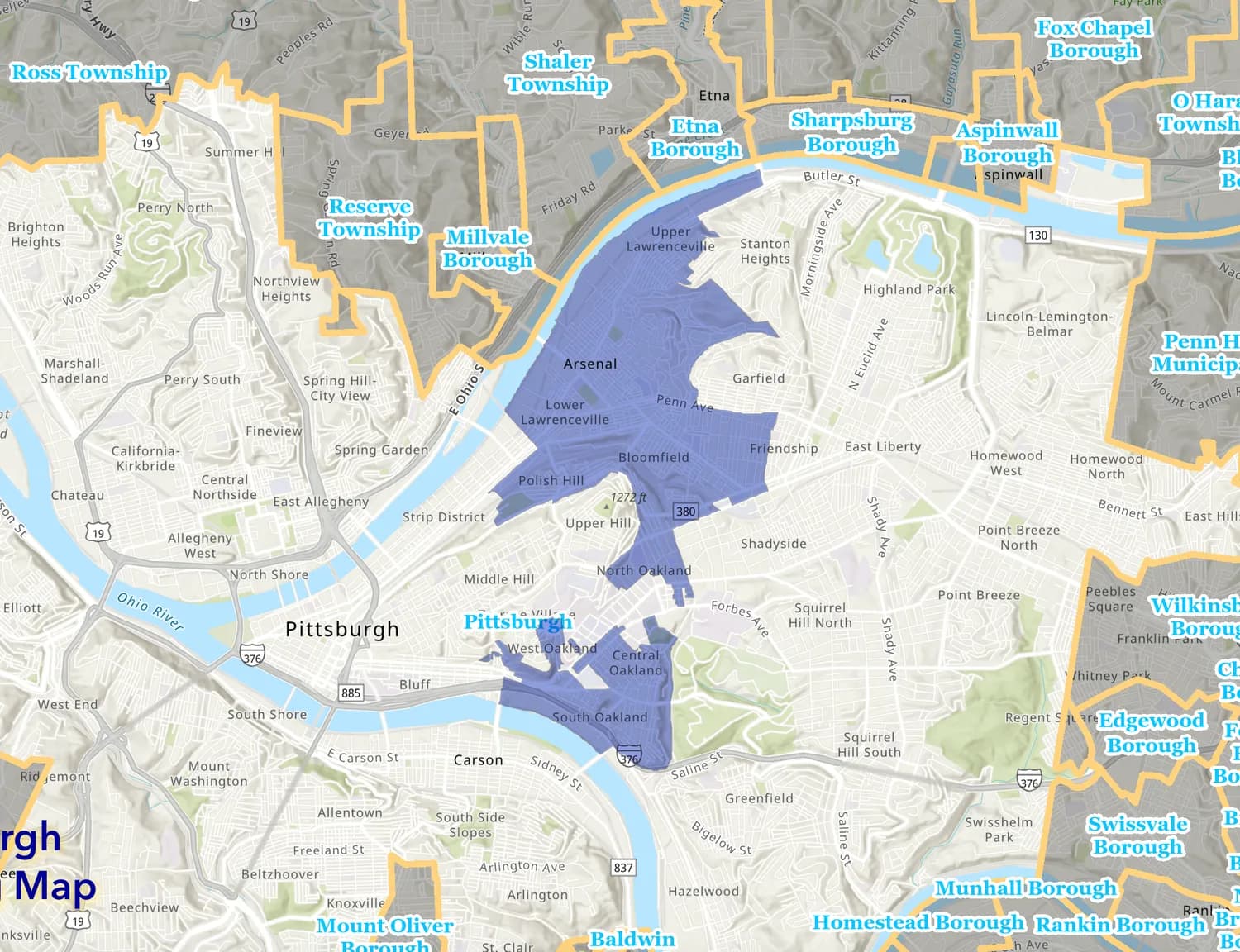
Pittsburgh adopted a temporary Inclusionary Zoning overlay in Lawrenceville in 2019, made it permanent in 2021, expanded it to Polish Hill and Bloomfield in 2022, and Oakland in 2023. City Councilmember Barb Warwick stated in a hearing on April 10 that she expected a bill to expand it citywide to be coming soon. Mayor Gainey has advocated for expanding inclusionary zoning citywide.
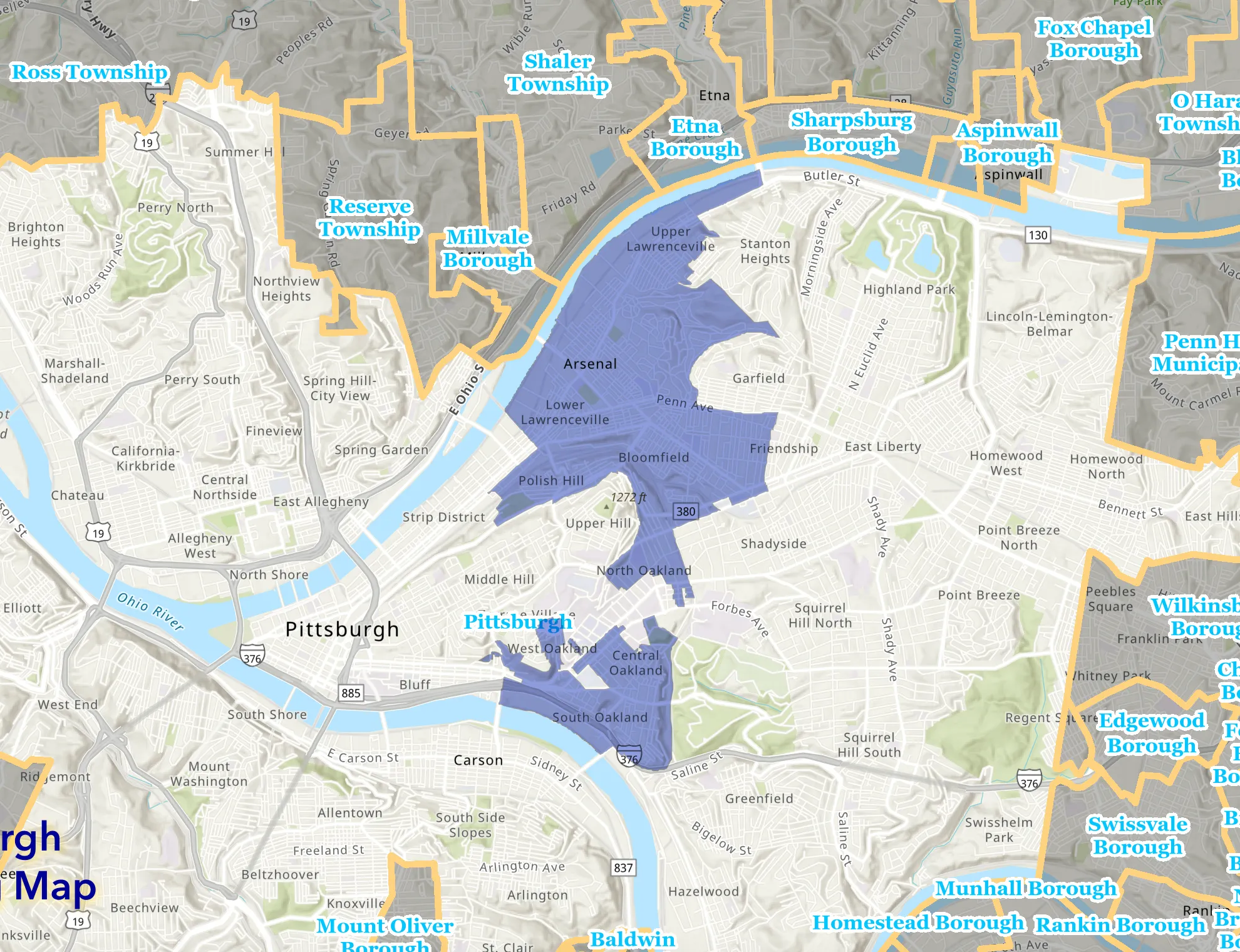
The current extent of Pittsburgh’s Inclusionary Zoning Overlay, covering all of Lawrenceville, Polish Hill, and Bloomfield, and part of Oakland.
Pittsburgh’s Inclusionary Zoning overlay mandates that new construction of 20 units or more must set aside 10% of units as affordable. If you require 10% of a buildings units to be sold or rented at less than half of market rate, that is effectively a tax rate of 5-10%.
If rented, the monthly rent can be no more than 30% of a household’s monthly income, earning 50% percent of “Area Median Income” (AMI). If sold, the initial sale can be no more than 28% of monthly income on housing costs assuming a 30-year mortgage with 5% down for a household earning 70% of AMI. Eligible households to rent can make no more than 50% of AMI or 80% of AMI if purchasing.
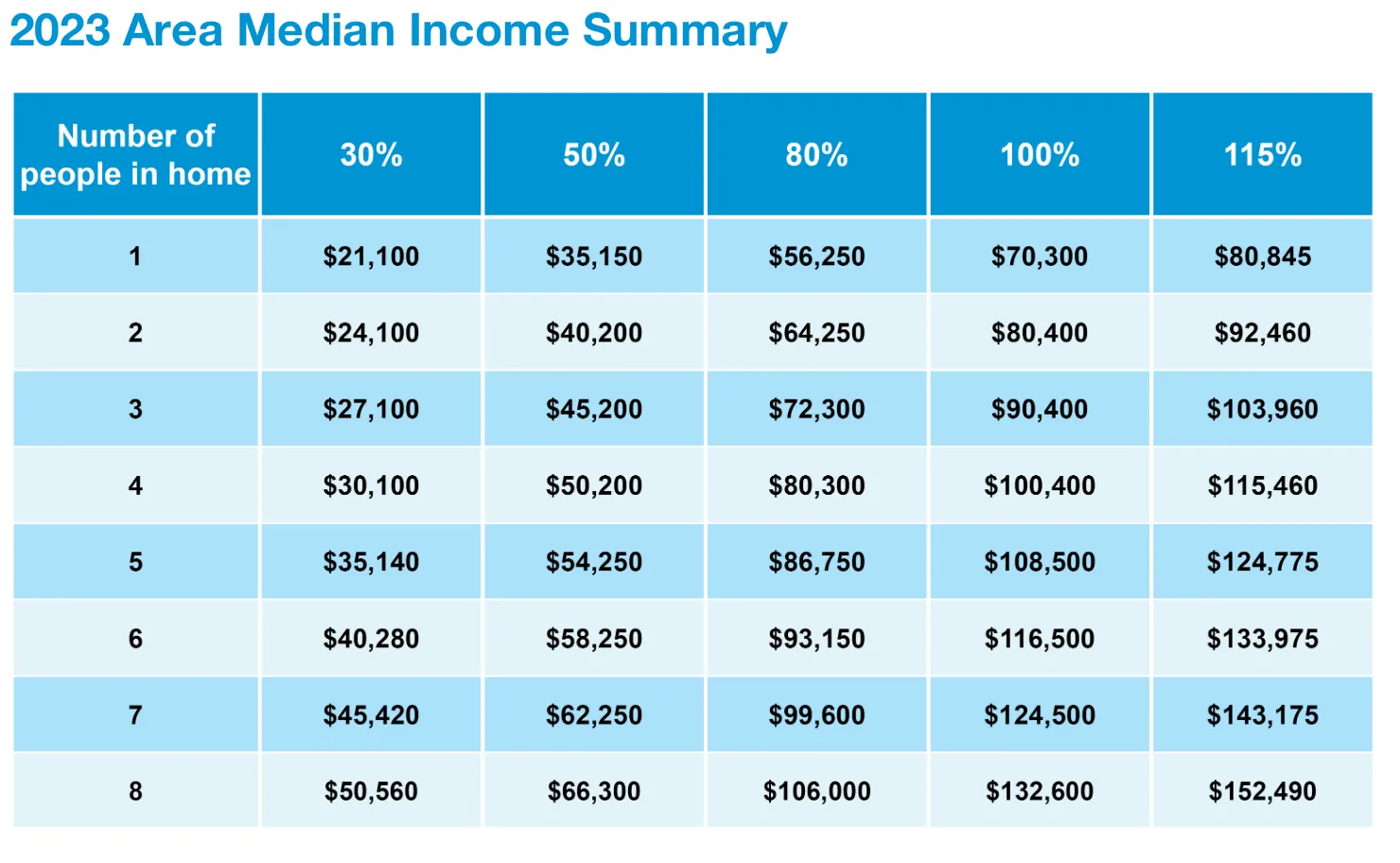
From Pittsburgh’s Urban Redevelopment Authority, a table of AMI for the Pittsburgh area in 2023, by number of people in the household.
Projects in Pittsburgh affected by the IZ overlay
Since Inclusionary Zoning was adopted in 2019, only one market-rate project of at least 20 units (and thus mandated by IZ to include affordable housing) has been built under the IZ overlay.
That project, Milhaus’ Arsenal 201 Phase II, is a 343 unit building with 35 affordable units. Notably, it was built in the RIV zoning district, which meant it did not require a variance and was part of an ongoing project that had been planned before the IZ overlay went into effect.
Meanwhile, in Bloomfield, Echo Realty’s plan to build a 248 unit building with 25 affordable units and a grocery store, was denied a height and Floor-Area Ratio zoning variance and will not be built absent additional concessions from the developer and city and a settlement to the existing lawsuit over the zoning for that building. This was the only project proposed in Bloomfield greater than 20 units under the new IZ overlay.
In Oakland, Walnut Capital’s Oakland Crossings project appears dead at this point, but a smaller incarnation of it might still be built. While Walnut Capital has not released any plans for the new project, it will almost certainly be smaller than the 426 unit project initially planned.
Finally, over at 3339 Ward Street in Oakland, Paramount Construction has scaled down their 20 unit plan from November 2021 to a 19 unit plan in December 2023. Presumably, they ran the numbers after the early 2023 expansion of IZ into Oakland and decided it was more profitable to have 19 market-rate units than to have 18 market rate units and 2 affordable units.
Overall, having created only 35 affordable units since its inception and potentially killing hundreds of units across other projects, the track record of our IZ policy supports the conclusion that the current IZ policy is not an effective policy for improving affordability in our city, and is certainly not something that should not be extended in its current form.
Suggested Policy
- Due to the negative impacts of the current IZ policy, Pittsburgh should not implement Inclusionary Zoning city-wide and should repeal it where it already exists.
- If the city does decide to keep or expand Inclusionary Zoning, then it should be implemented as a voluntary, incentive-driven program that includes the following incentives:
- Ease zoning restrictions significantly on projects in the IZ overlay
- Examples include removing or substantially easing height restrictions, floor area ratios, parking requirements, etc
- San Diego, CA and various jurisdictions across California provide bonuses to mixed income buildings that provide affordable units.
- Streamlined permitting and public engagement to get projects to shovel-ready faster, which helps reduce costs
- California’s SB35 provides streamlined permitting, public engagement, and approvals to projects meeting affordability guidelines.
- Fully fund the IZ program with tax abatements, public financing, or other methods
- Portland, OR has recently scrapped its unfunded Inclusionary Zoning program and is now fully funding the program after the unfunded program failed to produce significant results, similar to Pittsburgh
Resources:
Schuetz, J., Meltzer, R. and Been, V., 2011. Silver bullet or Trojan horse? The effects of inclusionary zoning on local housing markets in the United States. Urban studies, 48(2), pp.297-329.
https://journals.sagepub.com/doi/abs/10.1177/0042098009360683
Phillips, S., 2024. Modeling Inclusionary Zoning’s Impact on Housing Production in Los Angeles: Tradeoffs and Policy Implications. Terner Center for Housing Innovation.