

A Deep Dive into San Francisco’s Illegal Efforts to Evade State Law
September 16, 2026
Or: Is Swiss Cheese Contiguous?
San Francisco has made every effort, up to and including breaking the law, to avoid building new housing under SB 79.
Background
California Senate Bill 79, or the Abundant and Affordable Homes Near Transit Act, was authored by State Senator Scott Wiener, and signed into law October 10th, 2025. SB 79’s goal is to enable the building of multi-family housing within a half-mile of transit stops, such as along train and rapid bus lines, by increasing residential capacity in these areas, in order to make it easier for families to live and travel within cities. It does this by establishing statewide minimum zoning standards for allowed housing density and building height limits near major transit stops. In other words, SB 79 upzones parcels along transit lines.
As part of the compromises and carve-outs put into the bill, cities are given a number of tools to apply the letter of the law with a certain degree of freedom. One of these tools allows for the creation of a “transit-oriented development alternative plan,” which permits a city to implement the requirements of SB 79 in a more tailored manner, as long as the city’s housing near transit lines is “at least the same total net zoned capacity, in terms of both total units and residential floor area,” as SB 79’s total capacity.
All alternative plans are optional, and if a city didn’t pass one, the state-determined heights and densities automatically went into effect on July 1, 2026. Everything detailed in this report is entirely optional; San Francisco didn’t have to participate in this planning exercise at all.
Under SB 79, a city has the option to temporarily exclude, for seven years, relevant transit-adjacent areas if the area meets certain requirements. These include sites already within 50% of SB 79’s housing maximum, in very high fire hazard severity zones, vulnerable to a foot of sea level rise, with a historic resource designated on a local register, and for low-resource census tracts to give cities additional time to plan for increased housing capacity in these areas.
Finally, a city is allowed to permanently exclude certain areas within a half a mile of transit lines from its upzoning requirements if they are “industrial employment hubs” in order to make sure local businesses aren't competing for land with residential developers. San Francisco’s Planning Commission Transmittal stated “these permanent exclusions would help preserve specific land uses, the types of businesses and core city functions that operate there, and the jobs they support.”
San Francisco’s SB 79 Alternative Plan
If SB 79 were a test to see how Californian cities would react to the opportunity to build new housing, San Francisco would have flunked. Through dubious or outright illegal readings of the law, San Francisco has gone to great pains to reduce the effect of a bill designed to increase housing across the state. Two examples of this are the city’s use of industrial exemptions, and its abuse of the alternative plan clause to keep from building housing.
Industrial Exemptions
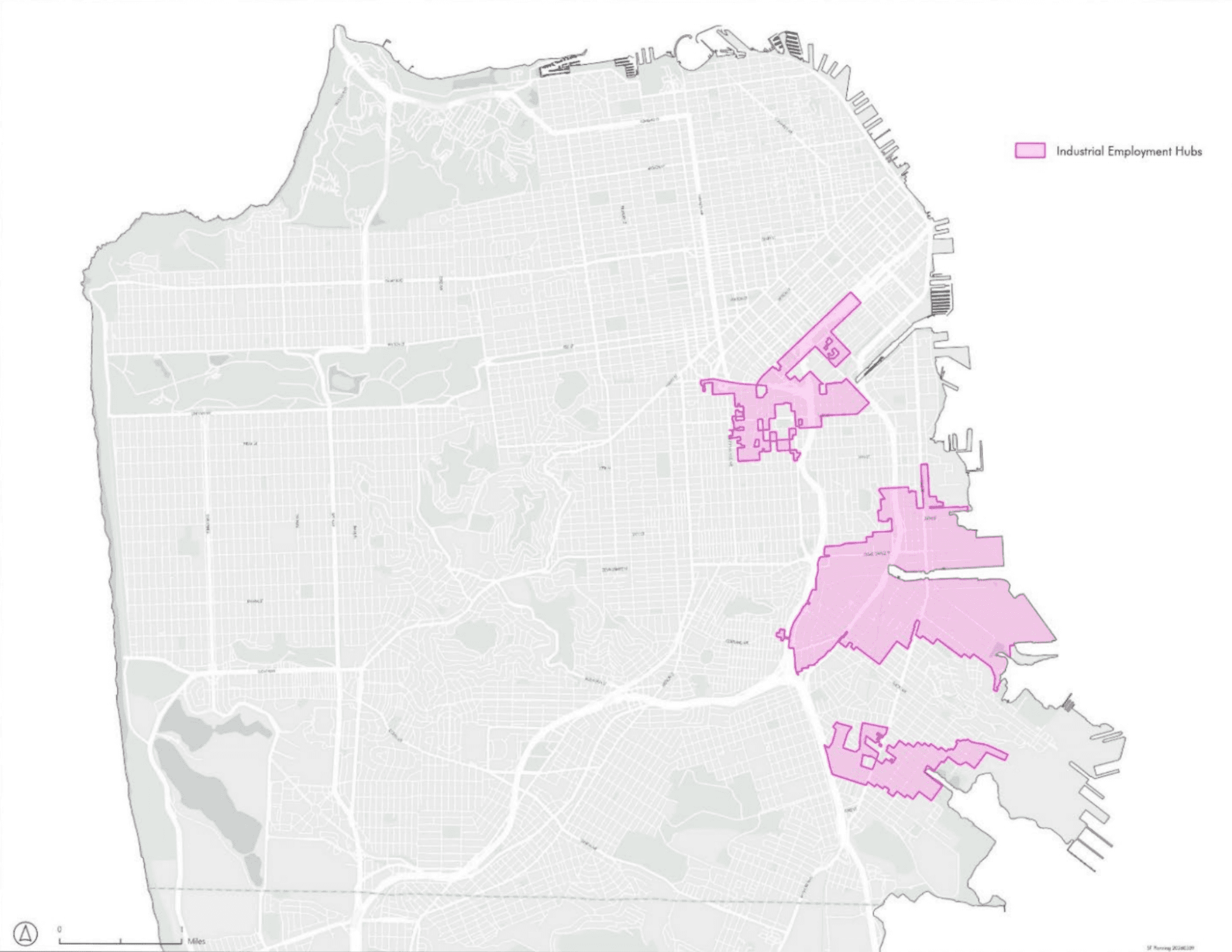
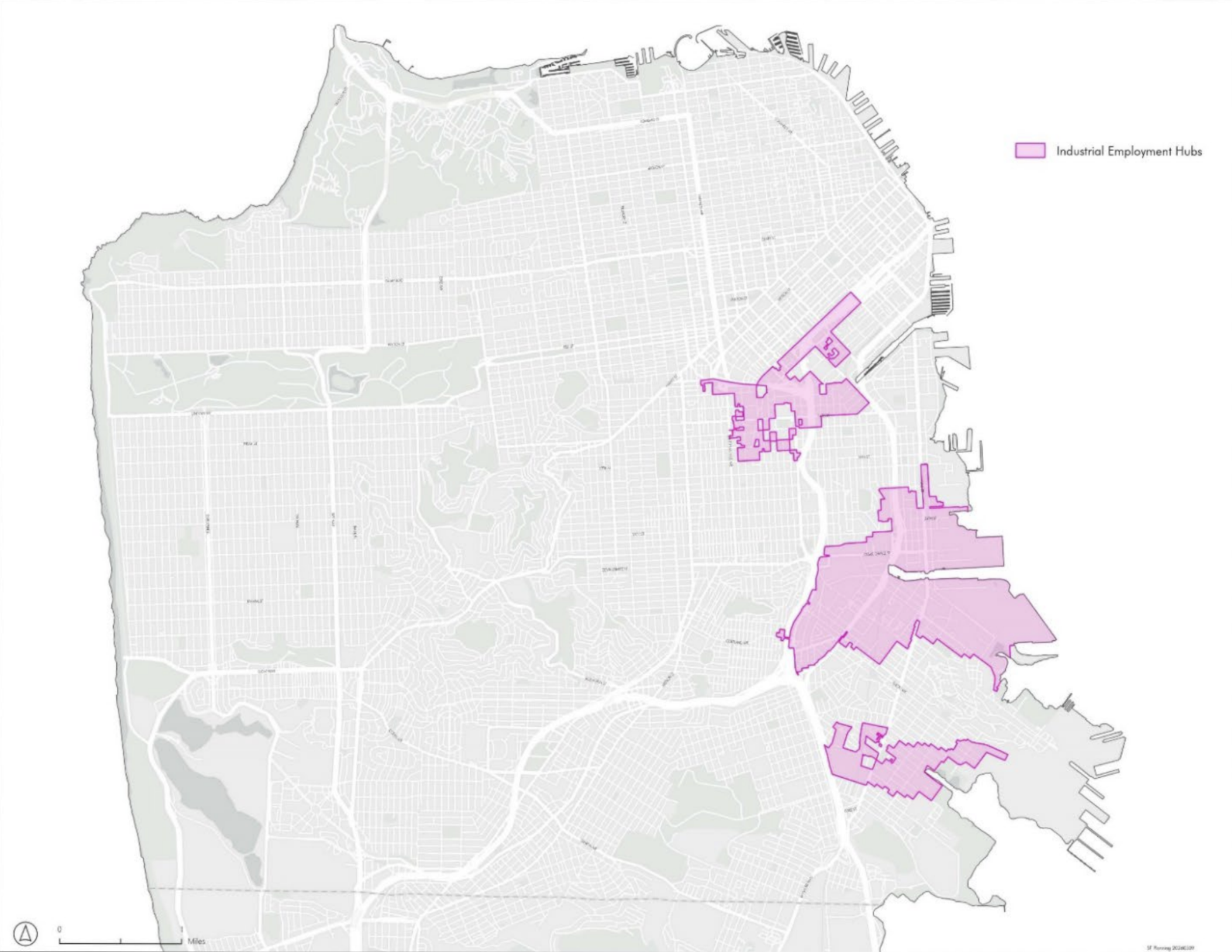
From the beginning, San Francisco’s SB 79 implementation has challenged the law. In its initial plan, the city attempted to use the industrial employment hub exemption listed above on parcels it blatantly was not allowed to. Using this industrial employment carve out, the city planned to exclude almost a tenth of itself from upzoning, despite the fact that these carve outs included places where housing is allowed, meaning the city had no authority to exclude them.
SB 79 lays out how a city can determine if a parcel qualifies for being permanently excluded as an “industrial employment hub” in Section 65912.160 (e)(2), which states:
“An industrial employment hub shall be a contiguous area of at least 250 acres designated in the jurisdiction’s general plan on or before January 1, 2025, as an employment lands area; the parcels within it shall be primarily dedicated to industrial use as defined in paragraph (3) of subdivision (f) of Section 65912.121; and housing shall not be a permitted use on any of the sites so excluded.”
By the city’s own count, its initial plan excluded 1,915 parcels, nearly 10% of the city across three major areas — 359 acres in SoMa/Mission, 1,150 acres in Bayshore/Central Waterfront, and 247 acres in Bayview. These parcels were subdivisions zoned as M (Industrial), SALI (Service/Arts/Light Industrial), PDR (Production, Distribution, Repair), WMUO (WSoMa Mixed Use-Office), and P (Public). With this exclusion, mixed-income housing would be permanently barred in these almost 2,000 parcels, because the city argues that these regions are critical industrial and employment hubs.
However, as can be seen in the above citation, there is a critical requirement that must be true of a parcel for it to be permanently excluded: “[H]ousing shall not be a permitted use on any of the sites so excluded.”
Of the 1,915 parcels on which the city attempted to permanently ban multi-family housing development, 276 of them were parcels where housing is a permitted use under San Francisco’s zoning laws. This means that more than one in every eight of the parcels included in the city’s permanent exclusion do not meet the requirements for permanent exclusion. Thus, the city is attempting to use SB 79, a bill designed to increase housing, to permanently ban it in places specifically intended to have it.
Looking at the 608 parcels of the SoMa/Mission exclusion, 216 of these parcels, zoned as SALI (Service/Arts/Light Industrial), permit housing under San Francisco’s own zoning laws. When discussing residential uses in SALI districts, Section 836 of San Francisco’s planning code states, “certain Affordable Housing Projects are permitted within the district pursuant to Section 803.8 of this Code, and Accessory Dwelling Units are permitted.” Affordable Housing Projects and Accessory Dwelling Units (ADUs) are housing, and SB 79 clearly states, “housing shall not be a permitted use on any of the sites so excluded.” SB 79 does not specify which, if any, specific types of housing are allowed, whether its provisions only apply to mixed-income, multi-family, or affordable housing. Therefore, it must mean that any form of housing counts as housing, regardless of if SALI zoning permits all forms of housing.
This bears repeating; SB 79 states that a subdivision cannot be included in an industrial employment hub if housing is a permitted use, and San Francisco has included parcels where housing is a permitted use in its permanent exclusions, a blatant violation of SB 79.
The city seemed to be aware of this, because in its own definition of what parcels can be included in an industrial employment permanent exclusion stated in a March transmittal, the city added a fateful word:
“Parcels that can be permanently excluded include: Those that are within an Industrial Employment Hub that is at least 250 contiguous acres, and as of January 1, 2025, is both designated as an employment area in the General Plan and does not principally permit housing development.”
Principally permitted has a stricter legal definition for use, but nowhere does SB 79 use the term “principally permitted” when defining what type of housing applies for a permanent exclusion. Under SB 79, a parcel cannot be permanently excluded if housing is permitted at all.
WMUO (WSoMa Mixed Use-Office) zoned parcels also permit housing, as according to Section 840 of the San Francisco Planning Code, which says that “Accessory Dwelling Units are permitted within the district pursuant to Section 207.1 of this Code.” In addition, Section 211.1 regarding P (Public) zoned parcels states, “the following uses are principally permitted in all P Districts when found to be in conformity with the General Plan,” including, “Residential Uses in 100% Affordable Housing Projects and Educator Housing Projects.” All three of these zoning types, SALI, WMUO, and P were included without exception into the permanent exclusions of the industrial employment hubs, despite the fact that they permit housing.
This exclusion is not just a hypothetical banning of housing where housing has been theoretically possible but has never existed. Almost 400 units of housing already exist on SALI zoned parcels across the SoMa/Mission “industrial employment hub” where housing development is now (as of May 5, 2026) banned. Of the 397 units, there are a number of apartments and affordable housing projects where people already live, including on 833 Bryant Street. On this property, Mercy Housing runs Tanahan, a permanent supportive housing for adults who have experienced homelessness, housing 146 people. On Tanahan’s website it notes that “residents have convenient access to public transit,” the exact kind of housing that SB 79 is attempting to support, as well as stating the building has been in operation since 2021.
This was part of the city’s initial plans, as proven by its transmittals and official statements. However, the city has since made a novel argument on shaky legal grounds in order to keep these exemptions. Per communication with the Planning Commission, the city now claims “parcels zoned SALI, M, or P were removed from the original list of potentially excluded parcels, though they are still part of the overall industrial employment hub. The industrial employment hubs are a broader contiguous area of which the excluded parcels are a subset.”
The city did not state why SALI, M, and P parcels were removed, but if they were removed because they allow housing, then WMUO parcels still face the same issue that SALI and P zoned parcels faced, in that they allow housing. And more notably, there is no place in the wording of SB 79 that allows for “subsets” of industrial employment hubs. To reiterate the criteria for an industrial employment hub, Section 65912.160 (e)(2) of SB 79 states:
“An industrial employment hub shall be a contiguous area of at least 250 acres designated in the jurisdiction’s general plan on or before January 1, 2025, as an employment lands area; the parcels within it shall be primarily dedicated to industrial use as defined in paragraph (3) of subdivision (f) of Section 65912.121; and housing shall not be a permitted use on any of the sites so excluded.”
If SALI, M, and P parcels were removed from the list of excluded parcels, the industrial employment hub ceases to be either contiguous or a minimum of 250 acres, making it invalid under the permanent exemption. Again, there is nowhere in the text of SB 79 that states a city can include a parcel in an industrial employment hub, an entity which exists to exclude parcels, while not actually excluding that parcel, calling into question where the city is basing their claim.
But this is not the only means by which the city is excluding these parcels. If the city cannot exclude them under the industrial employment hub provision, which it has not acknowledged if it can or can’t, then it will temporarily exclude them under the low-resource tract.
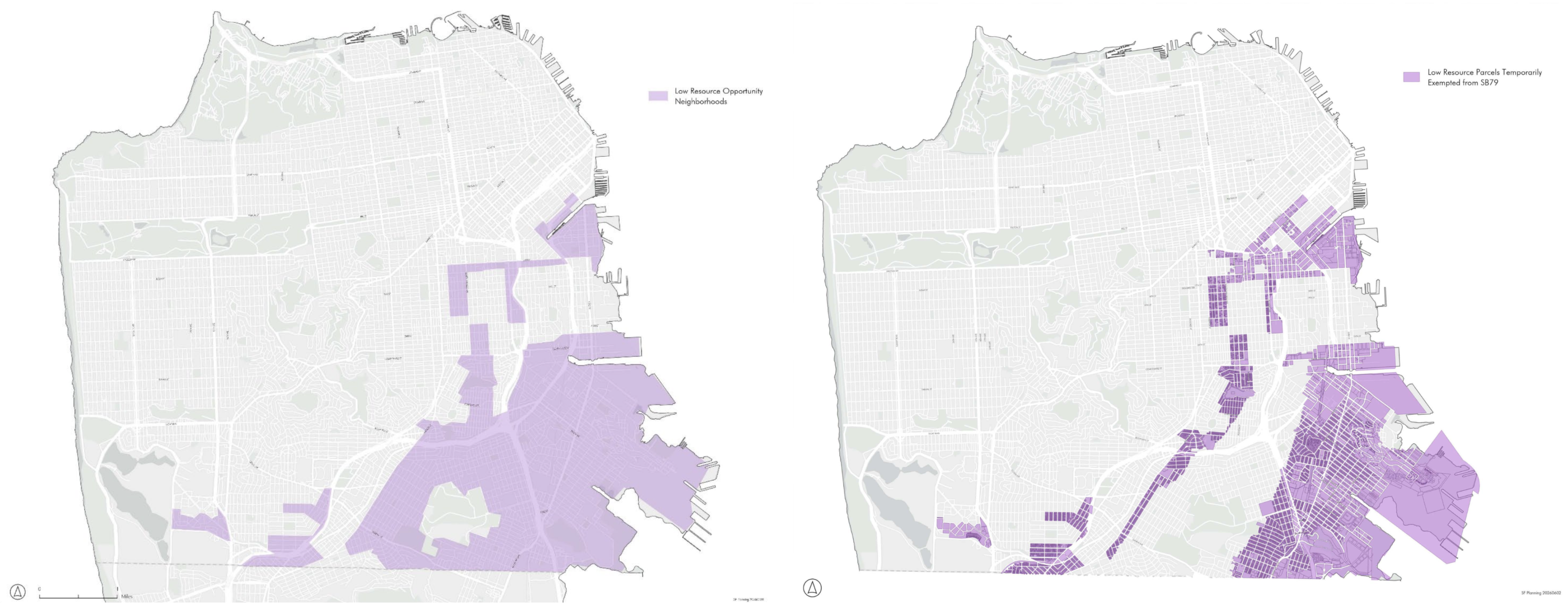
Original low resource map from March, more recent low resource map from at least July
As can be seen above, the new low resource map includes the SoMa/Mission industrial employment hub. This demonstrates just how far the city is willing to go to exclude parcels from upzoning, when if it had done nothing at all, upzoning for new housing would have automatically taken place.
Tricky Alternate Plan
In addition, San Francisco is using its alternative plan to argue that existing housing is a reasonable substitute for new housing. Essentially, SB 79 states that a city can create an alternative plan to SB 79’s upzoning if the city can prove that their alternative plan would create as much housing as SB 79’s upzoning would. San Francisco is arguing that its existing housing already meets SB 79’s calculations, because San Francisco has taller buildings than SB 79 demands. In essence, SB 79 laid out a new housing goal for San Francisco to meet, and San Francisco decided it already met that goal without building a single home.
San Francisco is arguing that it has to do nothing to comply with the law, which is absurd.
SB 79 calculates where a city should upzone its parcels by examining the neighborhoods that transit lines pass through, as well as the floor area ratio (FAR) of the buildings in that neighborhood.
There are two tiers of transit station areas under SB 79, Tier 1 and Tier 2. A Tier 1 stop is a heavy rail transit or very high frequency commuter rail, while Tier 2 is a light rail transit, by high-frequency commuter rail, or by a certain kind of high-frequency bus service. The law calculates the height limit of buildings according to the building’s proximity to a Tier 1 or Tier 2 station.
For Tier 1 stations, a building within a quarter mile must be allowed to reach a height of 75 feet, a floor area ratio (FAR) of 3.5, and a density of 120 dwelling units per acre (dua). Buildings within half a mile must be allowed to reach a height of 65 feet, an FAR of 3, and a density of 100 dua.
For Tier 2 stations, a building within a quarter mile must be allowed to reach a height of 65 feet, an FAR of 3, and a density of 100 dua. And finally, buildings within a half a mile must be allowed to reach a height of 55 feet, an FAR of 2.5, and a density of 80 dua.
Additionally, if a site is within 200 feet of a station, the building is subject to an "adjacency intensifier,” and cities must allow 20 feet of additional height, increase the FAR by 1, and permit an additional 40 dua. The information is summarized in the table below.
Tier — Distance — Height — FAR — Density
1 — 200 ft. (adjacent) — 95 ft. — 4.5 — 160 dua
1/4 mile — 75 ft. — 3.5 — 120 dua
1/2 mile — 65 ft. — 3 — 100 dua
2 — 200 ft. (adjacent) — 85 ft. — 4 — 140 dua
1/4 mile — 65 ft. — 3 — 100 dua
1/2 mile — 55 ft. — 2.5 — 80 dua
According to the city, this is what the heights of San Francisco would have looked like if SB 79 had been allowed to go into effect:
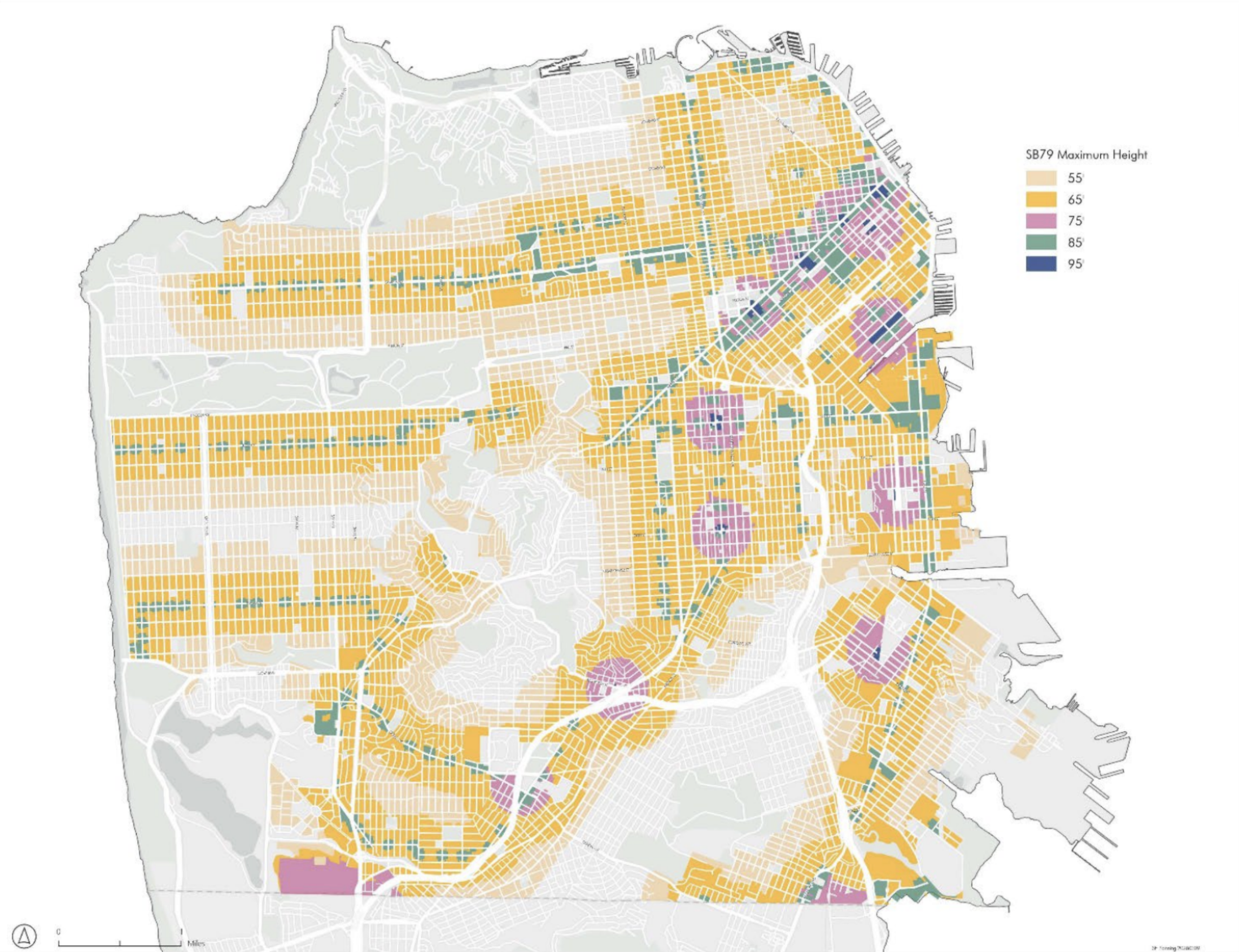
Using these calculations, SB 79 then determines what the new maximum housing capacity of the city would be if these heights were allowed to be imposed. It’s worth noting that there are no height limits determined to be above 95 feet, which is for a building within 200 feet of a Tier 1 station, but that this limit does not actually keep a building from being taller than 95 feet, only serving to be the height limit a city must reach if the building is so close to a transit station.
As previously mentioned, if a city for some reason does not want to be upzoned the way that SB 79 calculates, the law invites that city to come up with a “transit-oriented development alternative plan,” or just an alternative plan. According to Section 65912.161. (a)(1), an alternative plan, “shall maintain at least the same total net zoned capacity, in terms of both total units and residential floor area, as provided for in this chapter across all transit-oriented development zones within the jurisdiction.”
Clearly, the law intends that if a city does not wish to use the exact SB 79 height limits, it must come up with a plan that will increase housing as much as SB 79 would have increased housing.
However, San Francisco has interpreted this clause to mean something else entirely. Because SB 79 only calculates limits to be a maximum of 95 feet, while San Francisco has numerous buildings that are upwards of 300, 400, and 500 feet, San Francisco is arguing that it can use these excess heights above 95 feet to decide that it already met SB 79’s housing requirements.
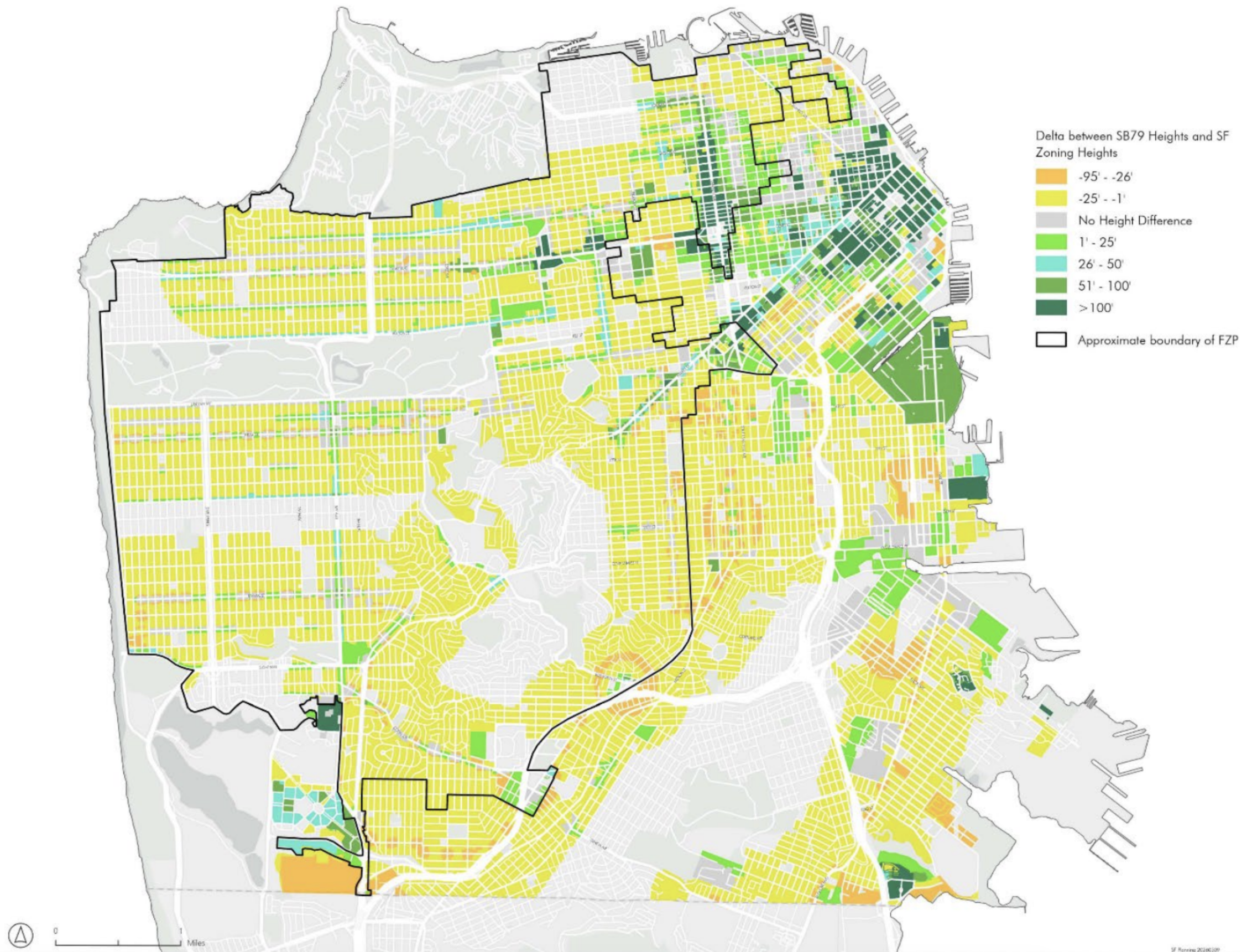
In this map provided by San Francisco, areas in green and light blue are where the city’s zoning capacity is greater than SB 79’s mandated upzoning, while yellow and orange represents where SB 79’s upzoning is greater than current San Francisco upzoning. Dark green shows where San Francisco’s height limits are greater than SB 79’s by over a hundred feet.
According to the city, the city’s alternative plan measures the aggregate of all of San Francisco’s housing capacity, meaning that where existing height limits are greater than SB 79 mandated height limits, this counts towards San Francisco’s housing capacity.
The clear intent of SB 79 is to increase housing by upzoning along transit lines, but San Francisco is arguing that because it has buildings taller than SB 79’s maximum height of 95 feet, it is already exceeding SB 79's mandates, which were clearly intended to be mandates for new housing, not mandates for existing housing. This interpretation flies in the face of the law, especially when the city is in the middle of such an egregious housing shortage.
The alternative plan for which the city is arguing comes with a number of benefits for the city, the most notable of which means that it wouldn’t have to increase the height limits of the city to SB 79’s calculations. To be included in the alternative plan, a parcel must be within 50% of SB 79’s maximum height limit (e.g., if SB 79 would upzone a parcel to have an 80 feet maximum, a parcel must be at least 40 feet). Essentially none of San Francisco would be upzoned beyond 50% of SB 79, because most of San Francisco is already within 50% of SB 79’s height limits.
As can be seen by the map provided by the city, San Francisco could have seen wide-ranging upzoning that could have made housing available across the city. Instead, with the alternative plan, only tiny portions of San Francisco would be upzoned, and only to be within 50% of SB 79’s height limits. Again, if the city had done nothing, huge swathes of San Francisco could have been upzoned. Instead, the city prefers to refuse housing using illegal, bad-faith interpretations of the law in order to keep things exactly the same in the midst of a widespread housing shortage.
Conclusion
San Francisco's handling of SB 79 reveals a consistent pattern. Its implementation of SB 79 describes a city working backward from a predetermined outcome — as little new housing as the letter of the law can be stretched to allow — rather than forward from SB 79's stated purpose of building homes near transit. The irony is that San Francisco could have done nothing at all: absent an alternative plan, the state's default heights and densities would have taken effect on their own. Instead, the city has spent planning staff time and taxpayer dollars to avoid a housing mandate it was free to simply implement. In the middle of one of the nation's most severe housing shortages, and an AI-exacerbated housing crunch, that choice is itself the clearest evidence of San Francisco's actual priorities.