
Half of Santa Rosa is Missing
November 14, 2024
How 47% of the Bay Area's 5th largest city became car infrastructure
Note: This is an edited version of a post first appearing on Adrian Covert's blog
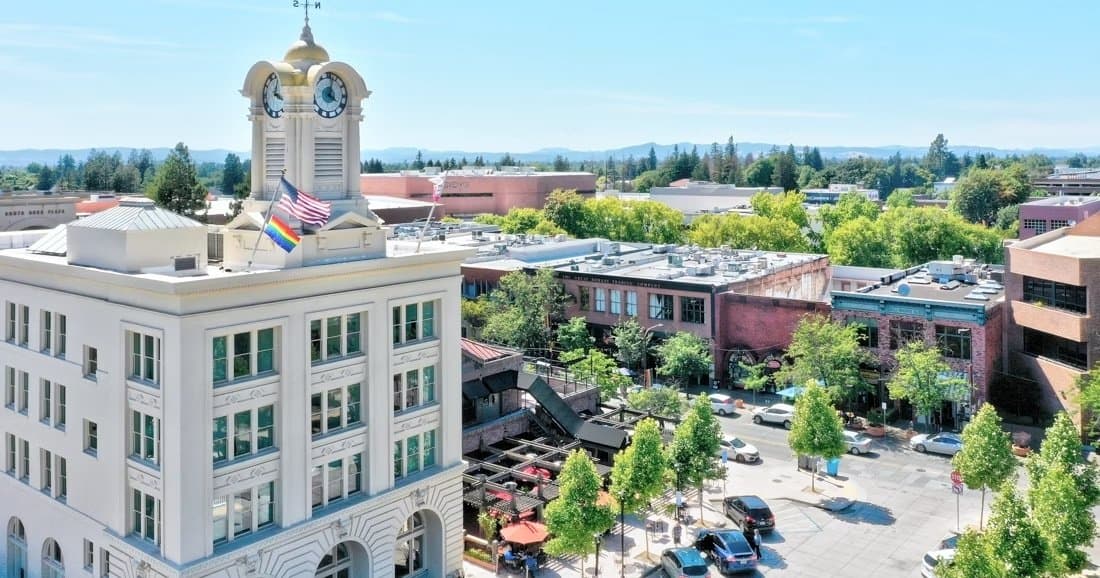
Santa Rosa is the Bay Area’s 5th largest city, the seat of Sonoma County, and an internationally recognized Mecca for wine and craft beer. Yet from a land use perspective, downtown Santa Rosa is mostly a place to transport and store cars. Nearly half (47%) of downtown Santa Rosa’s total surface area is just car infrastructure, counted as highways, streets, and parking. Santa Rosa’s existing car infrastructure came at the expense of about a third of its pre-car-era downtown and left behind a much less vibrant and sustainable city as a result. As the city works to update its general plan, it has a once-in-a-generation opportunity to build a better future—by looking to its past.
Like most towns in California, Santa Rosa was established in the late 19th century prior to widespread car ownership. A modern-day time traveler to historic downtown Santa Rosa would notice wider sidewalks, narrower streets, many more storefronts, and likely more people despite an overall much smaller population. By the 1940s, increased car ownership allowed more people to live in larger homes farther from jobs and markets while also making them dependent on cars for nearly all activities. Cars require a lot of space, not just to drive around but also to park while we shop, and most pre-car-era downtowns had very little space for parking. As a result, farms and ranches on what was then the edge of town were developed into new residential and commercial spaces—suburbs, motels, fast food, strip malls, and big box retail—with sprawling parking lots to accommodate car-dependent consumers. Downtowns across the U.S. fell into disrepair and sought to compete by expanding the space available for cars. Sidewalks were narrowed to make room for on-street parking and homes and businesses were demolished to make space for parking lots. By destroying homes, cities were also eliminating the local customer and employee base, which made downtowns even more dependent on car-dependent workers and shoppers, which led to even more demolitions and more car infrastructure. The destruction within cities like Boston, Philadelphia, Cincinnati to make room for car infrastructure was comparable to that in some European cities during the second World War.
Santa Rosa was similarly transformed. Commerce shifted away from downtown into car centric developments like Montgomery Village (1950), Coddingtown Mall (1962), and Stony Point Plaza (1980). Even when commerce did expand downtown, as it did with the opening of Santa Rosa Plaza (1983), not enough people lived downtown to support it so parking infrastructure had to be built to accommodate shoppers and workers living far away. Fifty-one housing units, a pool hall, and a hotel were demolished to build highway 101 through downtown; eighteen storefronts were demolished to make room for the parking lot at 5th and B Street; the parking lot at 6th and B Street demolished four homes and a church; the parking lot at 3rd and E Street was once two storefronts and 16 homes; a small Chinatown was demolished to build a parking garage on D Street. The Santa Rosa Plaza parking garage occupies the space of nine football fields and is almost certainly the largest building in Sonoma County, even larger than the mall itself. Where it stands was once home to 71 homes and 23 storefronts.