
All solutions
Fix incentives
Land Value Tax
Also known as Split-rate taxation (not to be confused with split roll); universal building exemption; land value return.
A land value tax shifts the tax off buildings and onto land, rewarding new housing and letting communities recoup value created by public investment. By contrast a property tax penalizes buildings.
Written by YIMBY LawWhat Land Value Tax does
High land costs and taxes on development drive up housing prices. Cities need a way to reduce land costs, lower onerous taxes on construction, and still pay for city services.
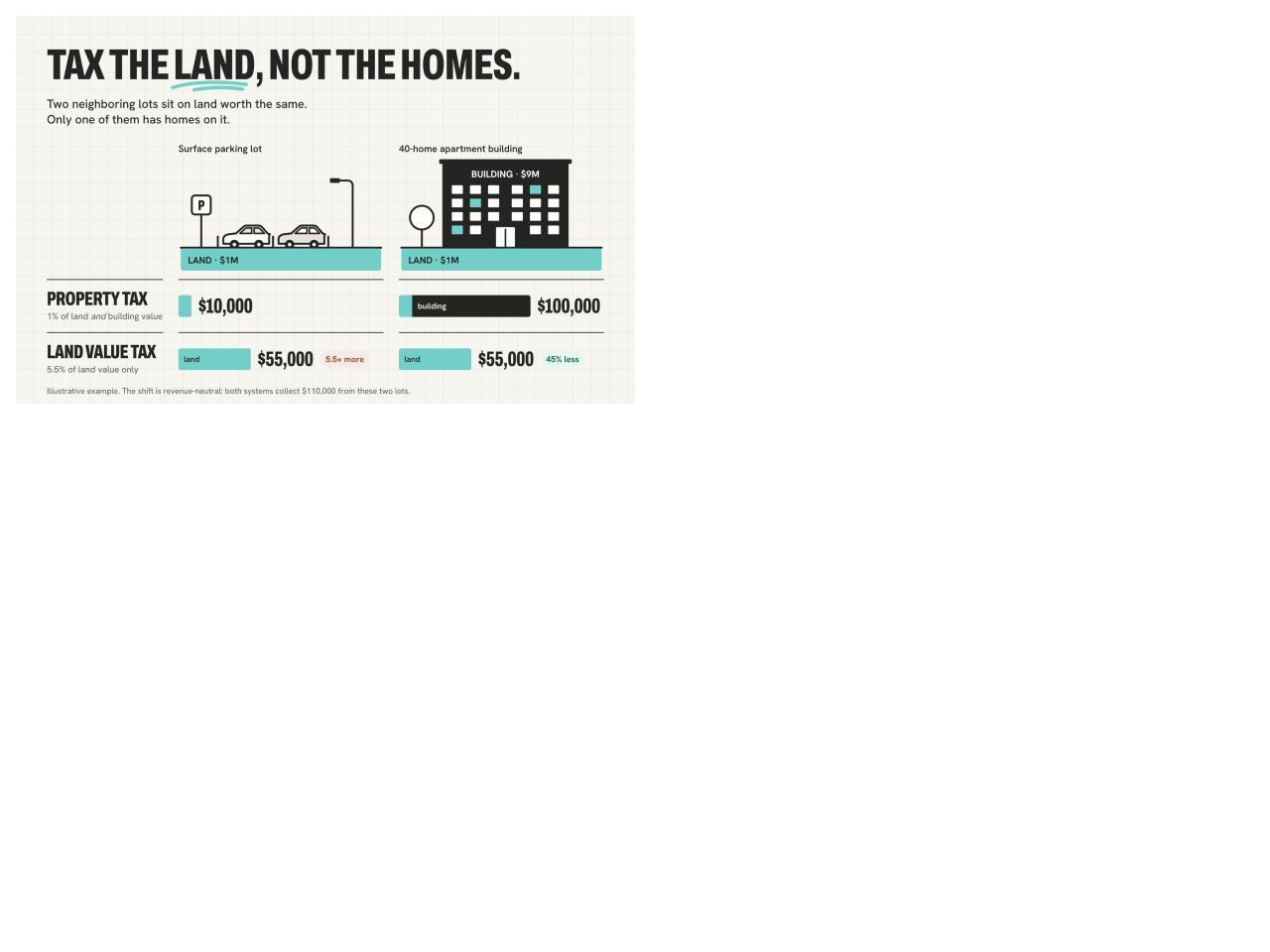
Property taxes are often statutorily limited and, because they tax buildings along with land, penalize development. A vacant downtown lot pays little, while an identical neighboring lot with an apartment building on it pays many times more. As a result, the most economical thing to do with a valuable lot is sometimes doing nothing at all (or use it for surface parking).
An LVT shifts taxation off of development and onto land. This decreases the cost of building both by removing a tax and by pushing valuable urban land into the market for development. At the same time, developers are incentivized to use land more economically. This tips the scales in favor of infill development.
Example legislation
Bills that carry this policy, passed and in progress.
- Passed
“Improvements to real property are declared to be a separate class of property and shall constitute a separate classification for local taxation of real property.” The bill caps the rate on buildings at or below the rate on land.”
Read the billVirginia HB 282
- Passed
Lets Louisville adopt a split-rate tax.
Read the billKentucky HB 607
- Passed
Budget language requiring a state report on split-rate taxation near rail stations. Withheld funds pending a planning department report on split-rate near rail stations in committee.
Read the billMaryland SB 282 (FY2027 budget)
- Active
“The land component of an assessment shall reflect the estimated market value of the land as if vacant and available for its highest and best use and shall not vary between similarly situated and zoned parcels based on the presence, absence, or value of improvements thereon.”
Read the billDistrict of Columbia B26-0777
Why localities should pursue a land value tax
The problem
Our current real estate tax system taxes land and buildings at the same rate, which discourages property owners from improving, developing, or building more housing because investments in buildings increase their tax burden. This creates an incentive to hold vacant or underutilized land rather than develop it, contributing to inefficient land use, housing shortages, and higher housing costs. A split-rate tax system addresses this by taxing land at a higher rate and buildings at a lower rate, encouraging owners to put valuable land to productive use, build more housing, and invest in property improvements without being penalized with higher taxes.
The fix
An LVT encourages denser development, especially on valuable urban land. Banzhaf and Lavery (2010) found that Pennsylvania’s split-rate tax increased development per acre, mainly by producing more housing units rather than larger ones. Plassmann and Tideman (2000) found that across fifteen Pennsylvania municipalities, the higher a city taxed land relative to buildings, the more building permits it issued.
An LVT also gives local governments a tax base that cannot be hidden or moved. This is especially important as a strategy for recouping the value of public investments like public schools, parks, and transit. A meta-analysis by Debrezion, Pels and Rietveld (2007) found that properties near rail stations sell at a premium of about 4 percent for homes and 16 percent for commercial buildings, value created by public investment that an LVT allows the public to recover.
The politics
Start with your Assessor. Valuing land (separate from buildings) is a solved problem, but not every Assessor knows how to do it (or does it well). LVT only works if the local assessor produces accurate and up to date land assessments. Confirm that first, or make fixing it the first task.
Next, look at state law. Most cities can’t tax land and buildings at different rates without state permission, and in states with strict uniformity clauses, the constitution itself might have to change. If your state hasn’t acted, the first campaign is enabling legislation, and the timing is good. In Kentucky, Louisville’s split-rate authority passed as part of a broader bill backed by Republican legislators, with bipartisan support from Metro Council members. In Virginia, the bill extending split-rate authority passed a Senate dominated by Democrats with unanimous support. LVT appeals to both fiscal conservatives and progressives, so you can and should build a broad coalition early.
Once the state clears the way, cities can move incrementally: a modest shift in rates, a pilot district, or a phase-in over several years. Pair the policy with clear parcel-level modeling using tools like LVT Shift (see resources section below). The goal is that most homeowners are neither surprised nor worse off. A reform that protects them can pass, and it’s far more likely to be a durable reform.
“”LVT encourages infill housing production by increasing the cost of keeping urban land idle and undeveloped.
YIMBY Law
Crafting the policy
What separates versions that produce homes from versions that produce headlines.
Must include
- State enablement to tax land at a higher rate
- High-quality land assessment
- Protections for the median homeowner
Watch out for
- Passing policy on top of bad assessments
- Major tax increases for the median homeowner
- Letting reassessments lapse
Why each one matters
After it passes
Here’s a checklist of things to be aware of to ensure implementation:
- 1
Make certain the local Assessor is up to date on land valuation methodologies and are publishing tests for land valuation integrity.
- 2
Ensure the Assessor is not overwhelmed by assessment protests during the transition period.
- 3
Make the Assessor's life easier with public educational materials they can post on their website; the more help they have implementing the policy, the better.
Make the case for land value tax
What to say at public comment, in a letter to council, or to a neighbor.
Talking points
Say them at public comment, put them in a letter to your council, or send them to a neighbor. Copy any one.
Allies & opposition
Who tends to show up for it, and who might need convincing.
7 likely allies
- Abundance Network
- Democratic Socialists of America
- Environmentalists
- Organized labor, especially the trades
- Sierra Club
- Strong Towns
- Transit advocates
6 potential opponents
- Car Dealership Owners
- Developers land banking entitled parcels
- Downtown Surface Parking Lot Owners
- Golf Course Owners
- Homeowners
- Property Tax Assessors
Research & resources
Related primers


Bringing this to your city council?
You don't have to make the case alone. Our chapters have passed policies like this before — join one, or start one, and bring the movement with you.