
Guest Blog by Scott Lucas
Jason Schwartz never expected to be crowding into a Methodist church in Herndon, Virginia on a Sunday this October. For one thing, he’s Jewish. And it wasn’t just Jason — among the nearly 1,000 advocates were members of many different faiths. “All these different denominations and prayer styles,” said Schwartz, the primary Arlington volunteer leader (Lead) for YIMBY Action’s YIMBYs of NOVA chapter. What drew them all together wasn’t religion, but housing.
Organized by VOICE, an interfaith group in Northern Virginia, and supported by the Commonwealth Housing Coalition, the event was the debut of the General Assembly’s pro-homes caucus, a group of 21 lawmakers who committed to introducing, among other bills, one that would make it easier for religious institutions to build housing on land they own. “Bold problems require bold solutions,” one of those legislators told the local news.
“It was amazing,” said Schwartz. What he didn’t say was that the rally symbolized the approach YIMBYs have taken across Northern Virginia — the region of the state that borders Washington D.C. and is home to more than three million people. Just like the interfaith group, YIMBYs here find their strength in their diversity.
One Region With Many Parts
“I don't know how other chapters function, but my impression is that our chapter functions a little differently because of the weird jurisdictional geography of Virginia,” said Alex Goyette, the YIMBY Action Lead for the city of Alexandria. First off, “we are in Northern Virginia, which is part of the D.C. metro region, but we're not D.C.” From there it gets even more complex. The region comprises six counties and the cities within them, as well as six independent cities that don’t belong to any county. Layer onto that a welter of regional groups, some of which extend across the Potomac and some of which don’t, and it’s a recipe for a headache. “We certainly see our D.C. counterparts at events,” said Jane Green, a regional Lead for Arlington and co-founder of YIMBYs of NOVA. “But it’s a different place. Baltimore is even farther away. Our region is enough.”
She points to a seven-acre parcel between Fairfax and Arlington that sums up how arbitrary — and consequential — those borders can be. The plot had been held by a family for many years and contained only a single, dilapidated home. It was bordered by single-family homes on one side and by apartments on the other. When the owner passed away, and it became possible to build new housing there, only single-family homes could be built because of its location just one block inside Arlington’s boundaries.
Another example of those arbitrary and consequential borders is Falls Church, a city of just under 15,000 people that seceded from Fairfax County in 1948. “Falls Church was created as an independent city specifically to exclude the black parts of town,” said Goyette. “They call themselves the Little City, and the reason they're so little is because they carved themselves up that way.”
Siloing for Success
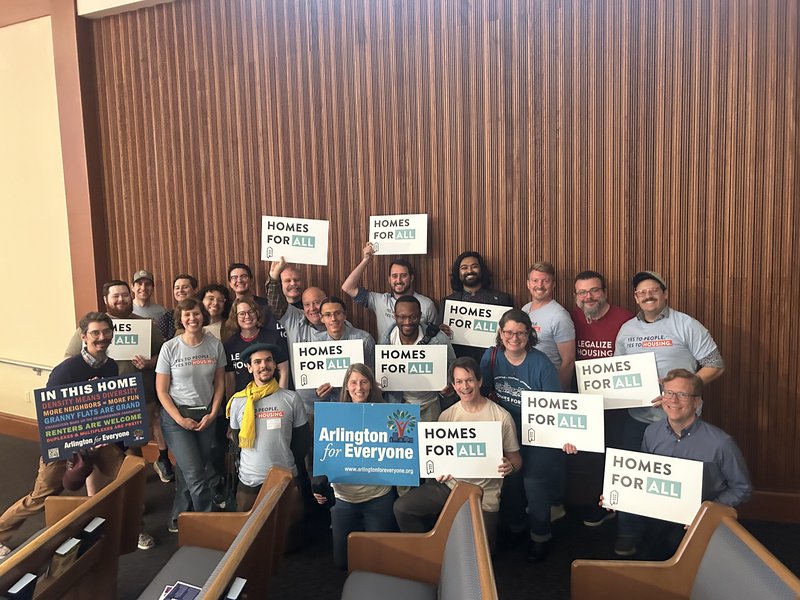
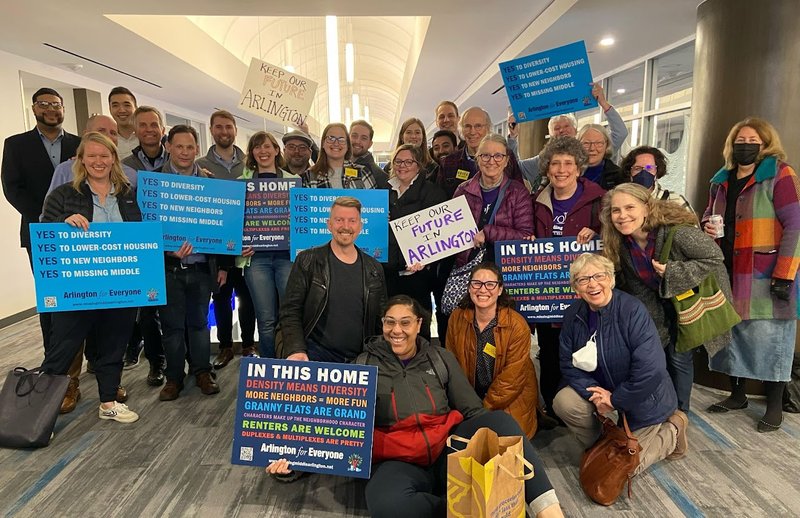
YIMBYs gained traction in Northern Virginia around 2022 when they organized in support of Arlington's successful efforts to end exclusionary zoning. (That “Missing Middle” plan passed, but it has been tied up in the courts.) “One of the things that got us a lot of new members was people walking or driving down the street and seeing the very aggressive anti-missing middle signs and people saying, ‘Well, that seems ridiculous. I want to be on the other side,’” said Green.
As YIMBYs built the local movement, they had to figure out if they should organize as one large group or as, to borrow the phrase, a house with many mansions. It wasn’t a hard choice.
“Because we cover multiple jurisdictions, we operate almost like we have subchapters within our overall chapters,” said Green. “There's a lot we can do that is centralized — we can manage one website, we can send a newsletter. But as far as advocacy goes, we’re generally only advocating in our own jurisdictions.”
“We intentionally siloed our work,” agreed Goyette, “in part because of the legitimacy factor. The first big process we engaged in as a chapter was the Missing Middle fight in Arlington. Throughout that process, there were accusations that we were these kids coming in from all over Virginia, which generally was not true. But that was a quick lesson to make sure that we were not intentionally activating people to come across county or city lines for these meetings.”
Practically, this segmentation of advocacy has led YIMBYs of NOVA to also segment its email list — it sends one monthly newsletter to the full list, but no more than that. Every other communication is segmented to go to only the people who have signed up to receive information about that city or county.
Thanks to its proximity to the nation’s capital, Northern Virginia does not lack for people sophisticated in policy matters, including housing. In addition to the Missing Middle reform in Arlington, the city of Alexandria passed a plan called “Zoning for Housing” in 2023. That plan is tied up in lawsuits too. “Our location cuts both ways,” said Goyette. Among the region’s NIMBYs are “a lot of very sophisticated high-powered attorneys.”
And while it can be frustrating to watch from the sidelines as the courts hear those cases, Northern Virginia’s YIMBYs have been focused on a number of other efforts. Among them are Alexandria’s update to its master plan and development of a new bus rapid transit system, an update to Arlington’s comprehensive plan, which was established in the 1960s, as well as specific area plans. Even in Falls Church, things are turning around, thanks in part to Mayor Letty Hard and recently elected member of the city council Justine Underhill, a filmmaker whose work explores housing and urbanism. “It’s kind of like dominoes,” said Schwartz.
Diving Deep and Emerging Victorious
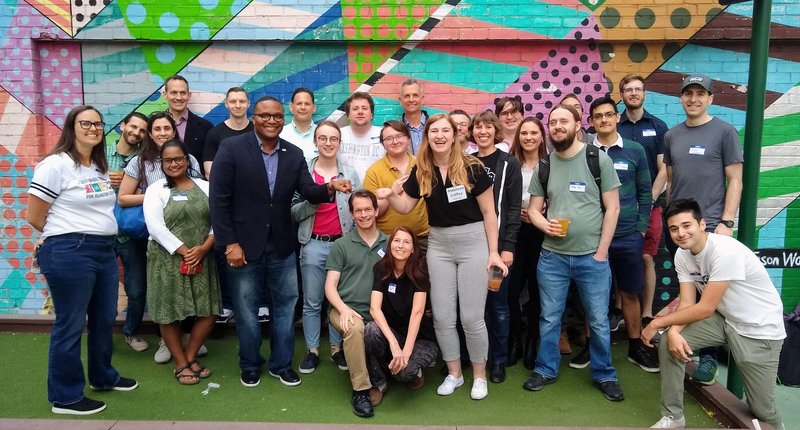
And those dominoes are now reaching the whole state. “We now have three other Virginia chapters, and we're all working on state level work in a larger coalition,” said Green. It’s been especially gratifying for her that Virginia has sidestepped some of the friction between social justice organizations and pro-housing groups that have occurred in other places. “Groups here that are primarily focused on vulnerable residents, and for whom truly affordable housing is their number one goal, recognize and embrace supply,” she said. “We are not fighting with our social justice related organizations. Together, we are calling for more supply, in addition to more support for specifically affordable housing and tenant protections.”
“Our structure has allowed us to go deep within each of our jurisdictions, instead of just having surface-level engagement. If there are chapters in other places where there's a fragmented jurisdictional situation, I do think that having subchapters or leads focused in each jurisdiction is a good idea,” said Goyette. And the model is clearly working. In 2025 alone, YIMBYs of NoVa have advocated for the successful approval of over 10,000 units of new housing in their region.
For YIMBYs in other places, those in Northern Virginia have a few lessons. Fragmentation can be good for volunteer-led organizations because it might not be cost-effective for staff-driven organizations to work deeply across many jurisdictions, large and small. A federated model allows organizers to avoid both isolating themselves from each other and to be connected to a larger whole, an especially useful structure when the problem reaches across multiple governments and levels of government. And, remember, when all else fails, the courts can be our friends — on November 12, a judge dismissed the case that NIMBYs in Alexandria had brought against its Zoning for All reform.