
A Bigger Boom
March 26, 2023
This member commentary post does not necessarily reflect the views of Asheville For All or its members.
This member commentary post does not necessarily reflect the views of Asheville For All or its members.
A recent Citizen-Times article reported that Asheville is undergoing a “building boom.” It’s not the only one. An article in January included the idea too, suggesting that Asheville has the “fastest pace of apartment construction in the state.”
But how true is it?
First, it’s important to put any growth in the number of new homes being built in the context of the local and national housing shortage. We know that nationally, there is a shortage of an estimated four million homes, and this has caused an uptick in homelessness and housing insecurity, longer commutes with more greenhouse gas emissions, real estate speculation, and maybe even lower birth rates.
Locally, we also know that the drastic housing shortage has led to a housing crisis, with homelessness, labor shortages, and displacement.
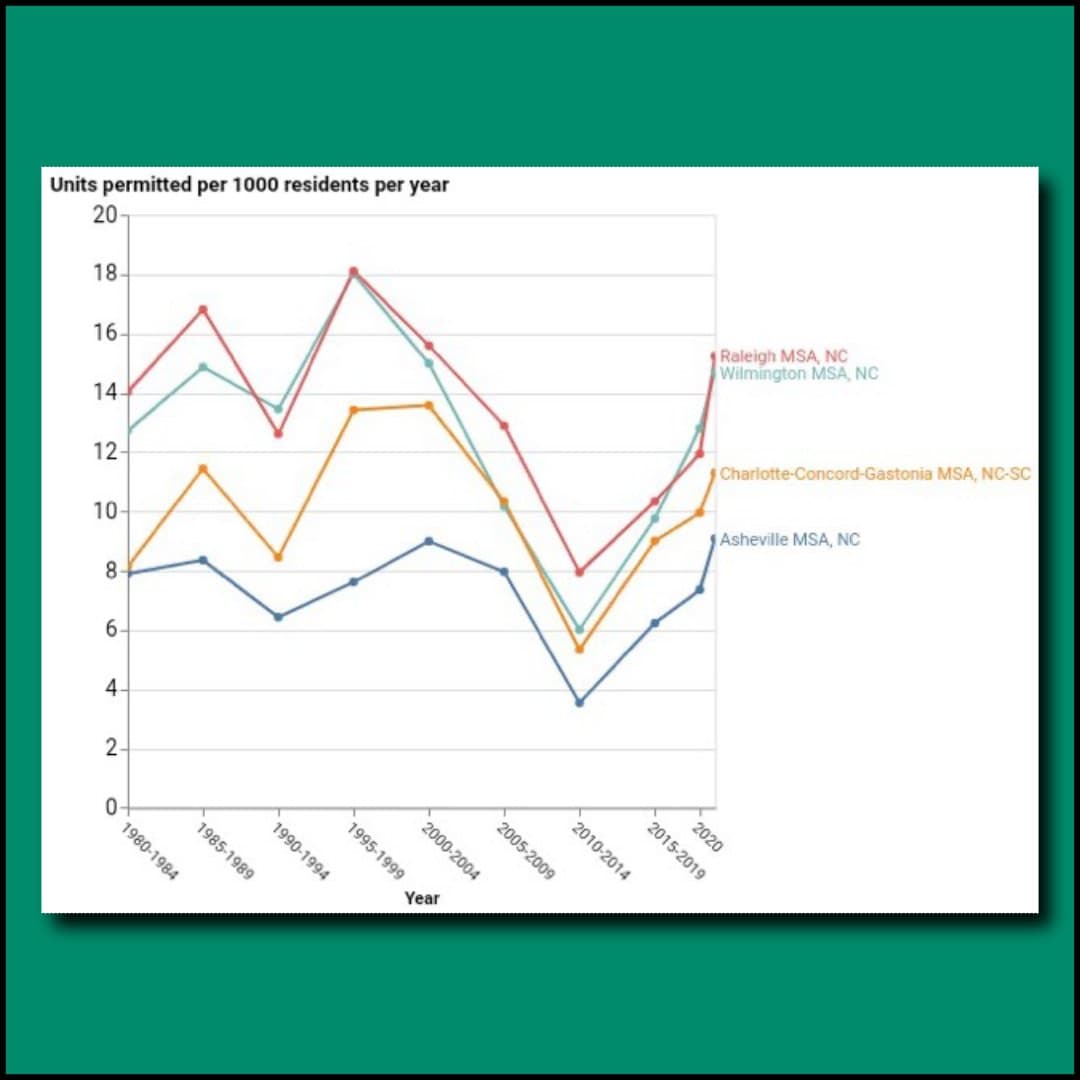
So here’s an image that we shared on our social media accounts last year, showing one of the reasons why Asheville has sky-high rents and home prices:
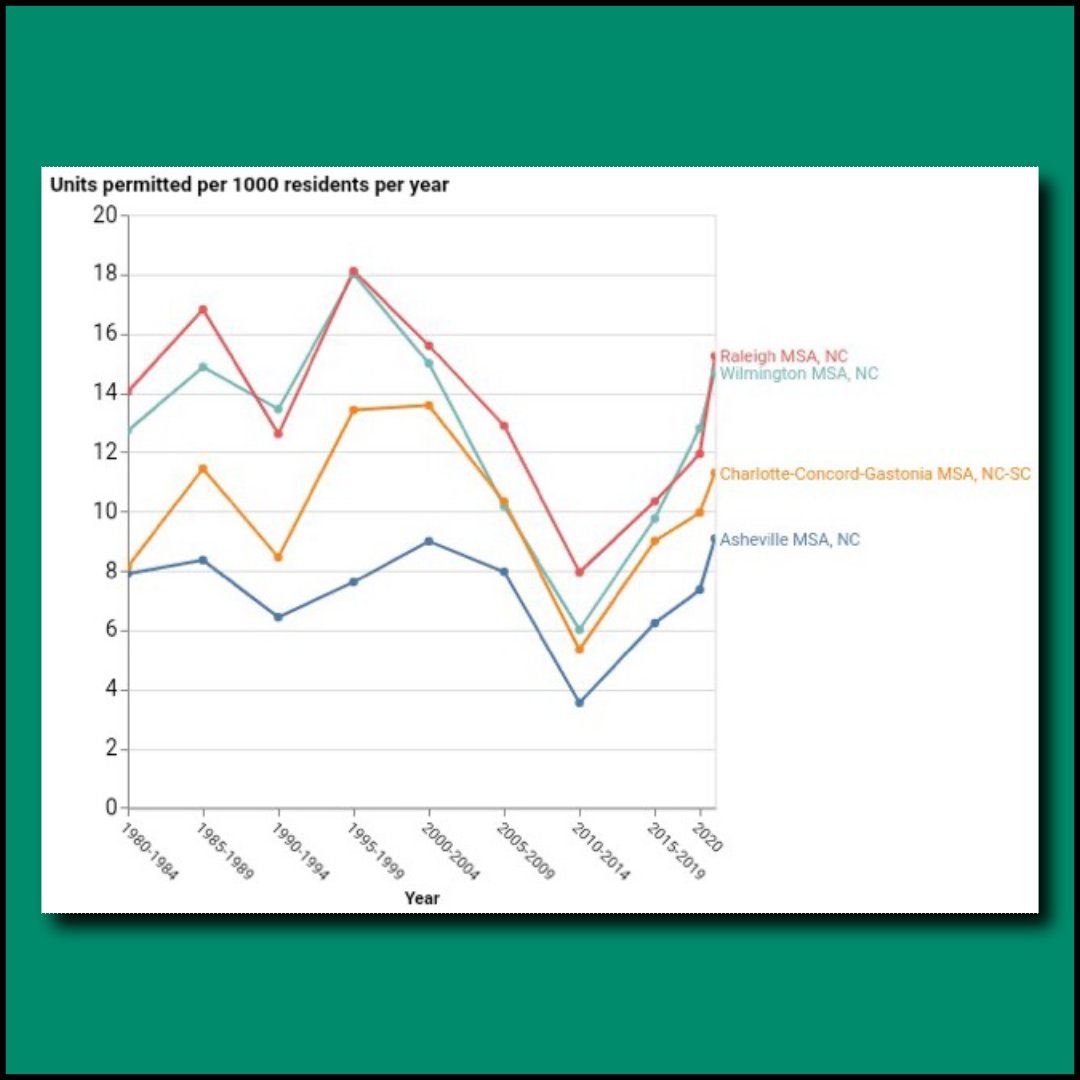
On a per-capita basis, Asheville consistently lags behind any other place in North Carolina when it comes to home building.
Why is “per capita” important? Here’s why:
For a moment, set aside any retirees that end up moving to Asheville, or new finance jobs bringing people to Charlotte, or new students coming to Chapel Hill.
Simply accounting for the fact that our population grows over time, with families having children, and those children starting families, we need to be increasing our housing stock. Millenials are the largest generational cohort ever, and the oldest of them are in their early forties. They are deep in their phase of family formation. So if we want young adults to be able to stay in Asheville, where they grew up—and we also want them to leave the basement where they might be living right now—we need more homes over time, at a certain pace relative to the existing population.
(None of this is to say that welcoming newcomers and outsiders isn’t important. But it is to remind us that at the root of Asheville’s engrained anti-“development” attitudes—ones that I think open the door for provincialism and xenophobia—is often a simple forgetting that it is normal for a place to need more homes over time.)
According to the aforementioned new Citizen-Times article, the “boom” that the region is experiencing represents a five percent growth in the pace of new housing. Forgive me if I find that number underwhelming! Looking at the chart above, even if the other regions hold steady, even a five percent increase in Asheville’s numbers keeps it dead last among the other metropolitan areas in North Carolina.
And remember the quote at the start of this post, that Asheville has the fastest pace of apartment construction in the state? This statistic appears to come from the same source, where again, the pace of construction is relative only to a city’s own prior rates of apartment construction.
To put it differently, if Asheville had a severe construction deficit, and then amped up just a little, this particular stat is going to be greater than North Carolina’s other cities that had previously been building more housing relative to their respective populations. But Asheville is not building more apartments than other cities in North Carolina, whether measured in actual numbers OR compared to population size.
If we’re in the midst of a housing boom—and I have yet to see evidence that we are—then we need a bigger boom.
(As an aside, I’ll note that a recent news story from WLOS presents conflicting information on the question of whether or not we are in a period of construction growth. The story suggests that “the number of units under construction has not increased” from the last year to this one.)
Why Missing Middle Matters
A bigger boom shouldn’t be scary to anyone that understands that cities, by their nature, will change over time. But we know that change comes difficult to some people, especially those that benefit from the status quo.
In any case, it’s important to say that all of the new construction that we need doesn’t need to come in the form of high-rises, multiple-acre complexes, or sprawling single-family-home subdivisions. In fact, this is exactly the idea behind the “missing middle” zoning reform that the city is currently exploring.
The concept of the “missing middle” comes from the observation that because of North America’s peculiar history of exclusionary zoning, many cities have a) neighborhoods characterized by suburban sprawl and b) a small amount of land with very large multifamily towers and/or complexes, but virtually none of the kinds of residential patterns that people generally find desirable and walkable: two, three, and four story walk-ups; duplexes, quadplexes, and low-rise apartment buildings, and other forms of “gentle density.”
Missing middle homes most certainly make more efficient use of land than our sprawling single-family homes, and so they can cost less to develop, and they can cost less to rent.
There is no guarantee that any one particular duplex or townhome will be “affordable” to rent (regardless of however you measure “affordability”). But missing middle housing is an important piece of the solution to increase our housing stock without adding sprawl, and the greater density that they bring can also make it easier for neighborhoods to attract the kinds of businesses, amenities, and transit that people need to cut down on (or eliminate entirely) the tremendous costs of automobile ownership.
And note that home ownership doesn’t have to look like a detached single-family home with a big yard. Increasing missing middle forms means increasing opportunity for renting and for owning too.
(Remember, the word “condominium,” which Ashevilleans inexplicably find so scary, simply means a townhome or apartment that you own instead of rent. Although some well-located condos are held up as scapegoats for high housing costs, it’s their general scarcity that makes them expensive, and as the Citizen-Times suggests, they are on average still less expensive to purchase than detached single-family homes.)
Personally, I think that Asheville could use some more high-rise apartments—with homes for rent, or to own—and taller, mixed-use complexes.
But more construction in the form of “missing middle” typologies may be more palatable to Ashevilleans. And if Asheville City Council can pass an ambitious “missing middle” reform to our zoning code, as the matter is now set to appear before them in 2024 or possibly 2025, we might actually be able to see some real change worthy of the phrase “building boom.”
This member commentary post does not necessarily reflect the views of Asheville For All or its members.