More Missing Middle for Asheville
April 15, 2023
April 15, 2023 Updated: November 25, 2025
April 15, 2023 Updated: November 25, 2025
The “Missing Middle”
Asheville’s “Missing Middle Study” was released on November 17, 2023. Read the PDF here.
Read Asheville For All’s response to the study here.
What Is the “Missing Middle”?
In cities across North America, we tend to have small downtowns with very large buildings, surrounded by very large areas with very small buildings.
That is, we often only have two extremes: high-rises, and detached single-family homes.
But it turns out that some of the most desirable neighborhoods in the country, ones that tend to have been built before the mid-20th century, look like something in between.
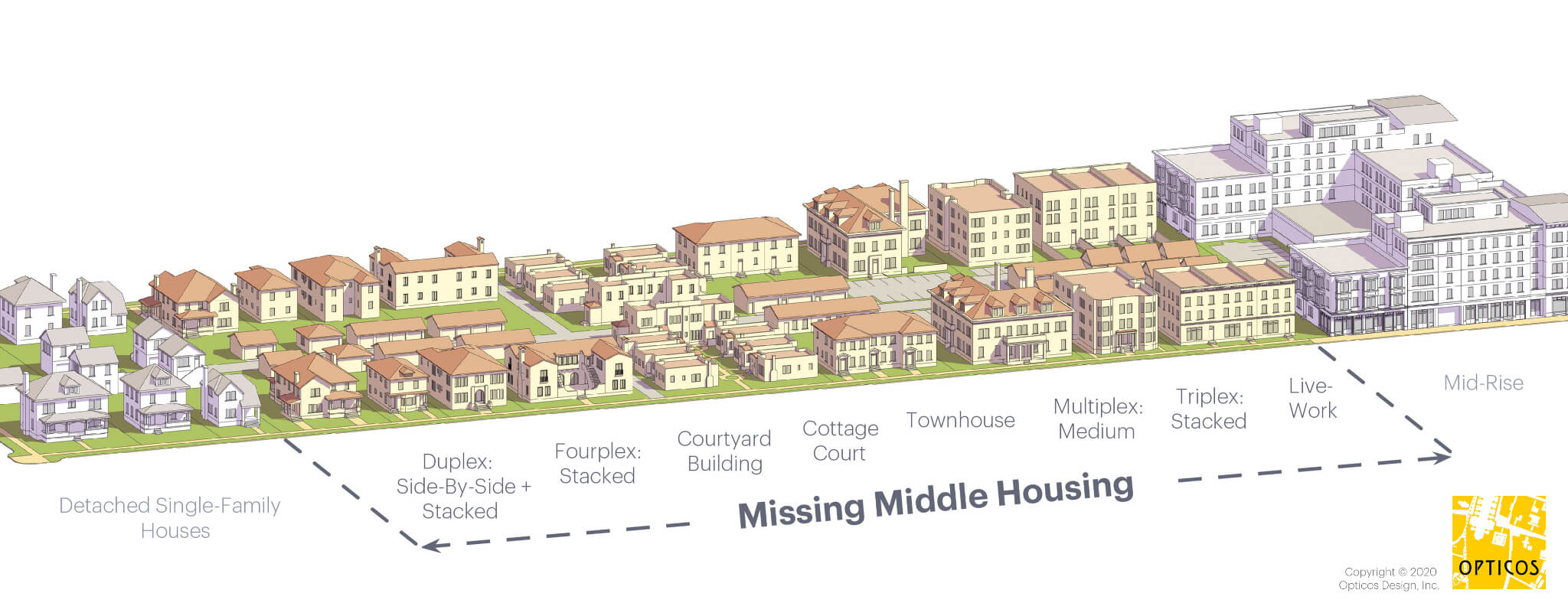
Image credit: Opticos, https://missingmiddlehousing.com
The kinds of housing in these neighborhoods are the “missing middle.” As you can see on the image above, they are in the “middle” of a spectrum of various densities and heights.
And they’re “missing” because after World War II, places like Asheville gave their land use almost exclusively over to sprawled out, single-family homes.
How Did “Middle” Housing Go “Missing” Exactly?
The reason why homes such as duplexes, quadplexes, triple-deckers, townhouses, and small apartment buildings went “missing” is a big story. But at least some of the reason can be boiled down to the phrase: “exclusionary zoning.”
In the early twentieth century, residents of some neighborhoods determined that they could make their communities more exclusive by restricting local land use. Banning multi-family homes, imposing mandatory setbacks and minimum lot sizes, and setting other restrictions meant that it would be harder for poor people to find homes in such neighborhoods.
This was segregation by another name. In many municipalities across the country, these new zoning restrictions were literally promoted by segregationists.
And after the Civil Rights Movement made formal residential segregation illegal, exclusionary zoning went into overdrive. Many city neighborhoods—including some in Asheville—were downzoned.
To some, this didn’t seem like a big deal at the time. The federal government was subsidizing our petroleum-dependent economy and our car-dependent lifestyles. The creation of sprawling new subdivisions seemed like the answer to the problems that exclusionary zoning posed.