

Guest blog by Steven Vance, Volunteer Leader for our Abundant Housing Illinois chapter.
Governor JB Pritzker announced his plan to address the state’s housing shortage in 2026. And this could be the year that land use and zoning reform happens in Illinois. The governor and General Assembly leadership are aligned since they, together, introduced bills covering six major land use, zoning, and housing development reforms.
Pritzker’s budget address in February covered a wide range of housing issues in four minutes:
- Illinois needs 227,000 new homes by 2030 to keep up with demand
- Everything is too damned expensive! Rent is too high!
- Not enough homes are being built
- Redlining played a role in housing being built less often in certain areas
- Regulations prevent new homes and small homes from getting built
- Bureaucratic red tape
- Parking requirements are arbitrary, wasteful, and expensive
Watch the full 4-minute housing speech, part of his hourlong budget address.
I propose some non-exhaustive reasons why the average Illinoisan might want to support these reforms:
- There are 6% year-over-year rent increases, which is making it hard for Illinois to be a competitive place to maintain its population and its services. Population loss results in higher costs for everyone because services and pensions are paid for by fewer people.
- I want Illinois to lose as few Congressional seats as possible in 2030.
- It encourages new development which spreads the tax burden onto more taxpayers and lowers it for any given taxpayer.
It’s a whole set of reforms to lower housing costs
To resolve these issues, Gov. Pritzker is working with legislative leaders in the Illinois House and Illinois Senate to adopt a package of bills:
Third Party Review (SB 4063, Ellman)
In cases where a municipality cannot review a building permit quickly enough, an applicant could hire a third-party reviewer. The municipality would have to complete its initial plan review within 15 business days for a one or two-family house, and within 30 business days for “any multifamily, mixed-use, or commercial project”. Each subsequent review cycle would need to be completed within 10 business days.
Additionally, the bill would set inspection standards, specifically requiring a municipality to perform inspections within two business days of the request. Applicants could also use a third-party inspector if the municipality does not meet the standard. Municipalities cannot charge additional fees if an applicant exercises this right, and qualified third-party reviewers and inspectors would not be permitted to charge more than the municipality’s fee.
Finally, the bill sets qualification, conflict of interest, and auditing standards. The bill would also apply to home rule municipalities.
Legalizing Middle Housing (SB 4060, Hunter)
This is a big deal and is a key to unlocking a solution to Illinois’ housing shortage. It would allow multifamily housing as of right on all lots that have a minimum area of 2,500 square feet. To give some context, the most common residential lot size in Chicago is 3,125 square feet. In Oak Park, the average residential lot ranges between 4,000 square feet and 13,000 square feet, depending on the zoning district.
The bill would permit between two and eight units of housing per lot in a residential zoning district, depending on the size of the lot. It would also permit new housing types that most municipalities currently ban:
- Duplexes (a.k.a. two-flats)
- Triplexes
- Fourplexes
- Cottage clusters
- Townhouses
- Stacked-flat plexes
- Attached courtyard housing
- Detached courtyard housing. This would allow a front house and an equal size rear house, which Chicago has vintage examples of. Some architecture firms have proposed these as part of the Missing Middle Infill Housing initiative, but the Chicago zoning code does not currently allow for them.
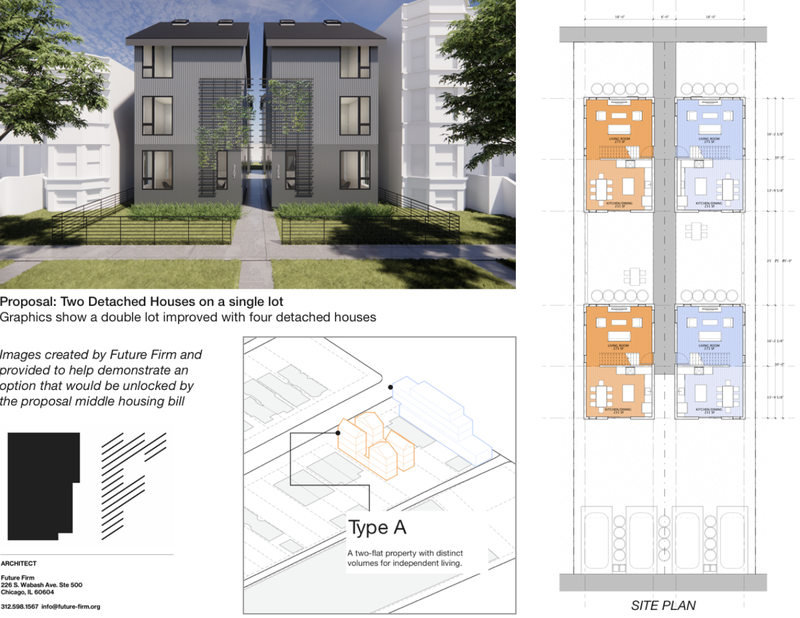
Future Firm, a design studio based in Chicago, created this concept that places two detached houses on a single property in Chicago. The current zoning code there does not permit more than one principal building per zoning lot, so if this were to get built the two houses would have to share some part of their structures.
What are some potential impacts?
In Chicago, there are 14,148 vacant lots that are zoned in a way that bans multi-family housing. If 5 percent of those were developed each year with a two-flat that would reduce the city’s housing shortage by 1,415 homes annually. (Chicago has seen an average of 4,357 new homes permitted from 2023-2025.) These zoning districts are pretty broadly distributed in Chicago, and overlap with all kinds of school attendance boundaries and near all kinds of amenities.
In Naperville, there are 35,449 (57 percent of the parcels in the city and 86 percent of parcels that allow residential uses) lots that ban multi-family housing. A minority of those would be improved to have two-family houses which would go a long way to increasing opportunity for Illinoisans (while also increasing Naperville’s property tax revenues).
That’s almost too simplistic (and perhaps a bit optimistic) because the bill would permit more housing types than Chicago currently allows, like the detached courtyard housing – these new options would respond to the desire for lower-cost detached housing, increasing or maintaining the density on blocks where deconversions and teardowns are common.
The need for housing extends beyond Chicago and Oak Park. I ran this exercise here because it’s where I have the easiest access to high quality property and zoning data. Every town needs additional housing and additional housing types – for its existing residents and for future residents. Every town with transit service especially needs more housing, because more people should be allowed to take advantage of that service and that public investment.
Parking Reform (SB 4064, Cervantes)
A municipality would not be allowed to require more than 0.5 automobile parking spaces per multifamily dwelling unit or more than one automobile parking space per single-family home.
And parking mandates would be eliminated for several uses:
- individual dwelling units that have an area smaller than 1,500 s.f.
- affordable housing developments
- assisted living developments
- ground floor non-residential uses in mixed-use buildings
- when converting a building from non-residential to residential use
The standards would also apply in home rule communities.
Single Stair Reform (SB 4061, Feigenholtz)
Residential buildings up to six stories, with a maximum of four dwelling units per floor, an automatic sprinkler system, and automatic door closers, would be permitted to have a single interior exit stairway (“single stair”). Small multifamily buildings with a single means of egress are as safe or safer than those with more than one.
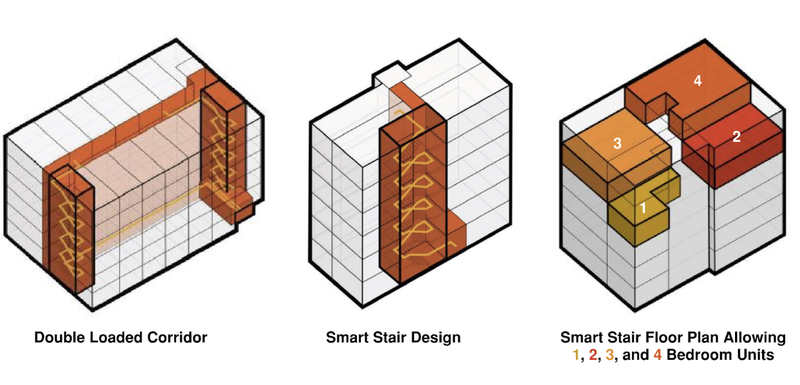
A typical new apartment building in Illinois has a “double loaded corridor” layout, which has a high apartment per stair ratio. The smart stair option in the center, not currently permitted, has a much lower apartment per stair ratio. The graphic on the right shows that a single stair building can have more variation in unit layouts and sizes (number of bedrooms).
The benefits improve quality of life by making it easier to design multi-bedroom and family-size homes with additional windows for more natural light, and inset porches (allowing for cross-breezes!) because space isn’t needed for a corridor to connect every unit to a second stairway. Homes are closer to the exit in these buildings.
Further reading:
- Minnesota study on fire risk of buildings with a single stair compared to buildings with more than one store
- Examples of “sunlight suites” in Seattle which has allow single stair for almost 50 years
- Additional research about single stair’s strong safety record from Pew
ADUs (SB 4071, Martwick)
Do I even have to say what this is about? The bill would permit accessory dwelling units in all zoning districts that permit residential uses. The state ADU bill, as written in HB5626, could possibly invalidate the labor requirements for coach houses in Chicago (emphasis added):
(1) Each municipality shall permit accessory dwelling units in all zoning districts that permit single-family dwellings without additional requirements for lot size, setbacks, aesthetic requirements, design review requirements, frontage, space limitations, or other controls beyond those required for single-family dwelling units without an accessory dwelling unit.
Impact Fee Modernization (SB 4062, Castro)
The state would create formulas that set maximum impact fees, relative to the impact (i.e. number of students, domestic water and sewer, etc.) and incorporate certain unique contexts, to establish certainty for home builders. Municipalities, include those with home rule authority, would have to adopt the formulas within 30 months after the bill’s effective date.
The House has this package in a single omnibus bill: HB 5626.

Abundant Housing Illinois volunteers were in Springfield yesterday to listen to Governor Pritzker’s budget speech and to push for bold housing solutions to reduce the housing shortage – evident by continually rising prices – that persists across the state.

The new bills that Governor Pritzker’s office announced today – collectively called the BUILD Plan – will have a big impact on permitting new starter homes and allowing multi-family housing all over the state, among other changes to speed up housing construction. These bills will have the biggest effect on reducing housing costs when passed collectively.
This guest blog is a cross-post from Steven Vance. If you want to support the BUILD Plan to help Illinois build more homes, use our digital tool below!